APAC Solar Control Window Films Market Crosses $585M : Ken Research Finds Urbanization Driving 2030 Growth
APAC Solar Control Window Films Hits $585M by 2030: Ken Research Finds Urbanization Fuels Growth | Ken Research
Executive Summary
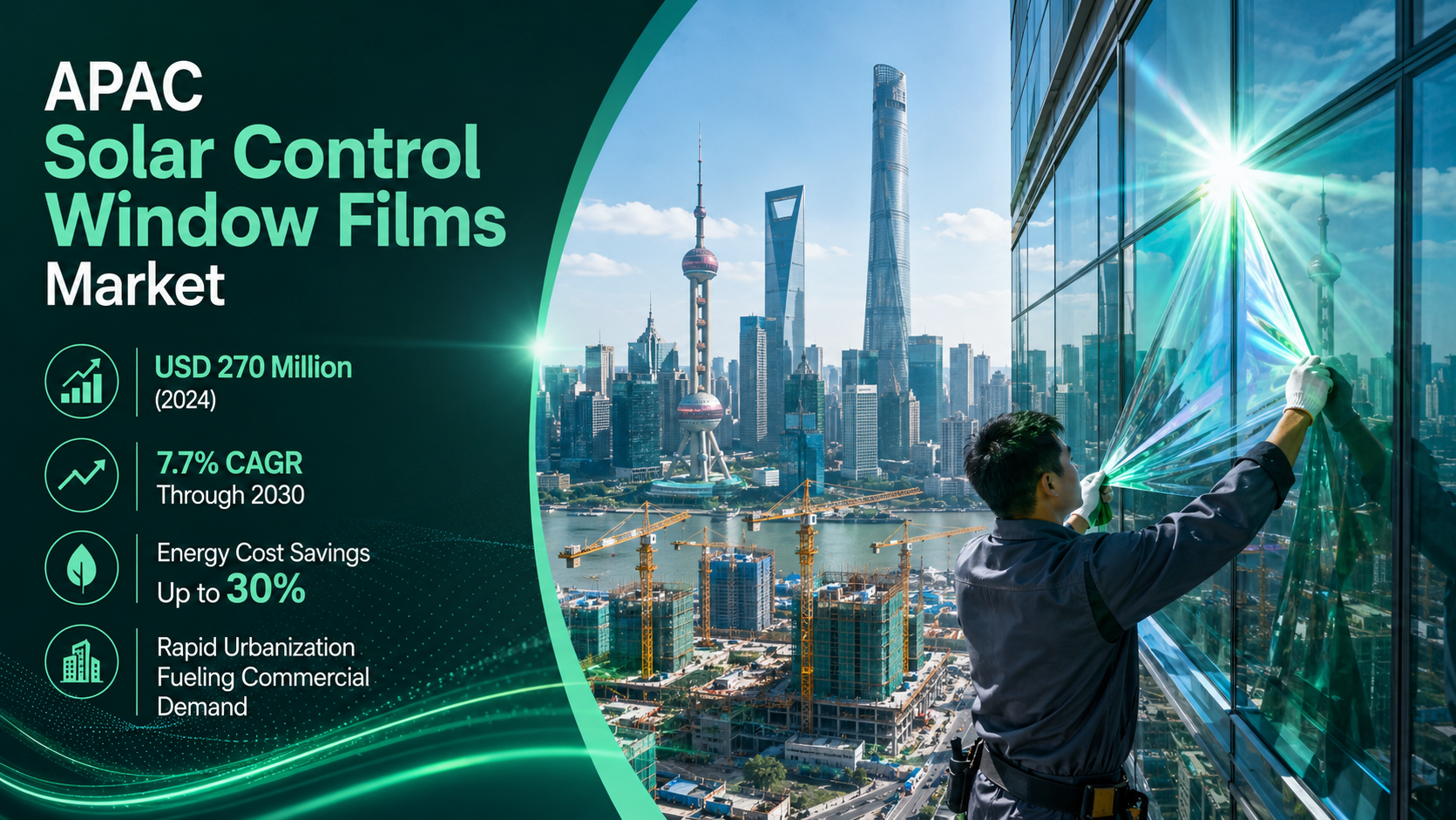
The APAC Solar Control Window Films Market, valued at USD 270 million in 2024, is projected to reach USD 584.85 million by 2030 at a 7.7% CAGR. Buildings account for 30% of global energy consumption, and solar control films deliver cost reductions of up to 30% per building. Mandatory energy efficiency codes, rapid urbanization, and surging EV adoption across China, Japan, India, and Southeast Asia are collectively reinforcing durable demand. Commercial real estate leads as the dominant adoption segment, driven by the proliferation of office towers and malls across APAC megacities.
Key Takeaways
- Market: USD 270 million (2024) growing to USD 585 million by 2030 at 7.7% CAGR
- Films cut building energy costs by up to 30%; buildings consume 30% of global energy
- Commercial sector leads with 55%+ APAC share; China and India are the largest markets
- Metalized films dominate; automotive segment growing at 9.2% CAGR on EV proliferation
Market At A Glance
- Market Size (2024): USD 270 million | Forecast (2030): USD 584.85 million
- CAGR: 7.7% | Region: Asia-Pacific
- Dominant Segment: Commercial | Leading Product: Metalized Films
- Key Players: 3M Company, Eastman Chemical, Saint-Gobain, Garware Suncontrol, Avery Dennison
Energy Efficiency Mandates Reshaping Building Practices Across APAC
Regulatory compulsion is the strongest accelerant for market adoption. Energy efficiency building codes with full compliance active since January 2024, and South Australia's specific implementation effective October 1, 2024, make solar film installations mandatory in a growing proportion of new commercial builds. Buildings account for 30% of global energy consumption, and solar films intercepting up to 30% of solar heat gain reduce HVAC loads and operating costs directly. LEED certification requirements in Singapore, South Korea, and India have made high-performance glazing film a prerequisite. Ken Research projects compliance-driven procurement will exceed 40% of total market revenue by 2027.
- Mandatory building code compliance active since January 2024 across multiple APAC jurisdictions
- LEED certification requirements mandating high-performance glazing solutions
- South Australia's specific solar control compliance standard effective October 2024
- Energy cost savings of up to 30% per building making ROI calculations compelling for developers
- India, positioned to become the 3rd-largest global construction market by 2025, adding significant procurement volume
Explore how energy efficiency construction trends are reshaping markets across Asia. Read Ken Research's analysis of Australia Commercial HVAC Rooftop Units Market and India Smart Grid Energy Storage Market for the full picture of APAC's energy efficiency transformation.
Urbanization and Commercial Real Estate Driving Dominant Segment Demand
The commercial sector commands the largest share of APAC solar control window film demand. The region added 3.2 billion square feet of Grade-A office stock between 2019 and 2024, each requiring window film to meet energy codes. Southeast Asia's urban population grows at 2.3% annually, sustaining a robust construction pipeline across Vietnam, Indonesia, Malaysia, and Thailand. Ken Research finds commercial real estate demand share will remain above 55% of total APAC film consumption through 2030, reinforced by net-zero building certifications and ongoing skyscraper development in Singapore, Shanghai, and Mumbai.
- Commercial segment accounts for more than 55% of total APAC solar film demand through 2030
- Grade-A office stock additions of 3.2 billion sq ft across APAC from 2019 to 2024
- Southeast Asia urban population growing at 2.3% annually, sustaining new commercial build volume
- Net-zero building certification requirements in Singapore, South Korea, and Japan creating premium demand for advanced ceramic and metalized films
- For related market dynamics, see Ken Research's Indonesia Heavy Construction Equipment Market and GCC Ultra-High-Performance Concrete Market
Automotive Segment and EV Adoption Opening a High-Growth Secondary Channel
The automotive solar film segment is accelerating rapidly, propelled by China and Japan's EV expansion targets. Films reduce interior temperatures by up to 15 degrees Celsius, directly extending battery range by cutting air-conditioning load. China's EV fleet, targeting 60 million registered vehicles by 2030, creates a structurally large recurring retrofit and OEM installation channel. India's two and three-wheeler EV segment added solar film as OEM standard from 2022, opening a new volume channel. Ken Research finds the automotive segment will grow at 9.2% CAGR through 2030, outpacing the overall market rate of 7.7%.
- China EV fleet: 60 million+ vehicles by 2030, creating OEM and retrofit demand
- Films cut interior temperatures by up to 15 degrees Celsius, extending EV battery range
- Automotive segment CAGR: 9.2% versus 7.7% overall market rate
- See Ken Research's Global Automotive Thermal Management Market
Competitive Landscape: Global Leaders and Regional Challengers
The market features a tiered competitive structure. 3M Company leads through premium positioning in Japan, South Korea, and Australia. Eastman Chemical's LLumar brand dominates Southeast Asia aftermarket, backed by decades of distribution investment. Saint-Gobain bundles film with glazing contracts across India and China. Garware Suncontrol captures cost-sensitive ASEAN buyers with metalized films priced 20-30% below global brands. Ken Research identifies installation costs averaging USD 8-15 per square foot as the primary SME adoption barrier in emerging APAC markets. See Ken Research's Malaysia Flooring Market and Malaysia Smart Manufacturing and Industry 4.0 Market for specialty materials context.
- 3M leads premium; LLumar (Eastman) dominates Southeast Asia aftermarket with decades of distribution investment
- Garware Suncontrol priced 20-30% below global brands in ASEAN; Saint-Gobain bundles film with glazing contracts
- Smart film (electrochromic, PDLC) is the next growth frontier at estimated 12-15% CAGR within the overall market
Conclusion
The APAC Solar Control Window Films Market will more than double from USD 270 million to USD 585 million by 2030 at a 7.7% CAGR. Energy efficiency mandates, rapid urbanization, and EV proliferation are collectively creating durable, policy-reinforced demand across all major APAC economies. Ken Research's analysis confirms commercial real estate, automotive, and smart film technology as the three primary value creation vectors through 2030, with solar control window films transitioning from a retrofit preference to a fundamental building specification across Asia-Pacific.
Access the full APAC Solar Control Window Films Market report and explore related energy efficiency markets including Kuwait Insulation Market, Saudi Arabia Thermal Insulation Materials Market, and Vietnam Smart Meters Market. Contact Ken Research to request a custom industry briefing.
Ken Research Finds
- Market reaches USD 584.85 million by 2030 at 7.7% CAGR from USD 270 million in 2024
- Buildings consume 30% of global energy; solar films cut building energy costs by up to 30%
- Commercial real estate commands 55%+ of APAC demand through 2030
- Automotive segment CAGR: 9.2%, driven by China's 60 million+ EV fleet target by 2030
- India to become the 3rd-largest global construction market by 2025, unlocking major procurement volume
- Installation costs of USD 8-15 per square foot remain the primary SME adoption barrier
- Related APAC markets: Thailand Home Improvement Market
Q1: What is the current market size of the APAC Solar Control Window Films Market?
The market was valued at USD 270 million in 2024, projected to reach USD 584.85 million by 2030 at a 7.7% CAGR, representing more than a 2x increase. Growth is driven by mandatory energy efficiency codes, commercial real estate expansion, and EV adoption across the region's 6 major economies.
Q2: Which countries drive the highest demand for solar control window films in APAC?
China leads with the largest share, backed by USD 1.4 trillion in annual construction investment and government energy mandates. India is positioned as the 3rd-largest global construction market by 2025. Japan and South Korea drive premium demand through stringent VLT regulations, while Australia's mandatory compliance standards effective October 2024 are adding a new regulated demand stream.
Q3: What types of solar control window films dominate the APAC market?
Metalized films dominate, blocking up to 99% of UV radiation and cutting solar heat gain by 40-60%. Ceramic films lead the premium segment by avoiding GPS and radio signal interference. Smart films grow at an estimated 12-15% CAGR within the broader market, targeting luxury and government buildings.
Q4: How do energy efficiency regulations in APAC impact the solar window film market?
Mandatory building energy codes from January 2024 make solar film non-optional across a growing proportion of APAC commercial builds. South Australia's standard effective October 1, 2024 exemplifies proliferating subnational mandates. Ken Research estimates compliance procurement will exceed 40% of total revenue by 2027, up from 22% in 2023.
Q5: Who are the key competitors in the APAC Solar Control Window Films Market?
The market is led by 5 players: 3M Company, Eastman Chemical (LLumar), Saint-Gobain, Garware Suncontrol (priced 20-30% below global brands), and Avery Dennison. No single player holds a majority APAC share. Installation costs of USD 8-15 per square foot are the primary SME barrier. See Ken Research's Malaysia Laboratory Filtration Market.


Comments
Post a Comment