Bahrain Color Cosmetics Market at USD 35M: Social Media Fuels 80% Purchase Influence | Ken Research
Bahrain Color Cosmetics Market at USD 35M: Social Media Fuels 80% Purchase Influence | Ken Research
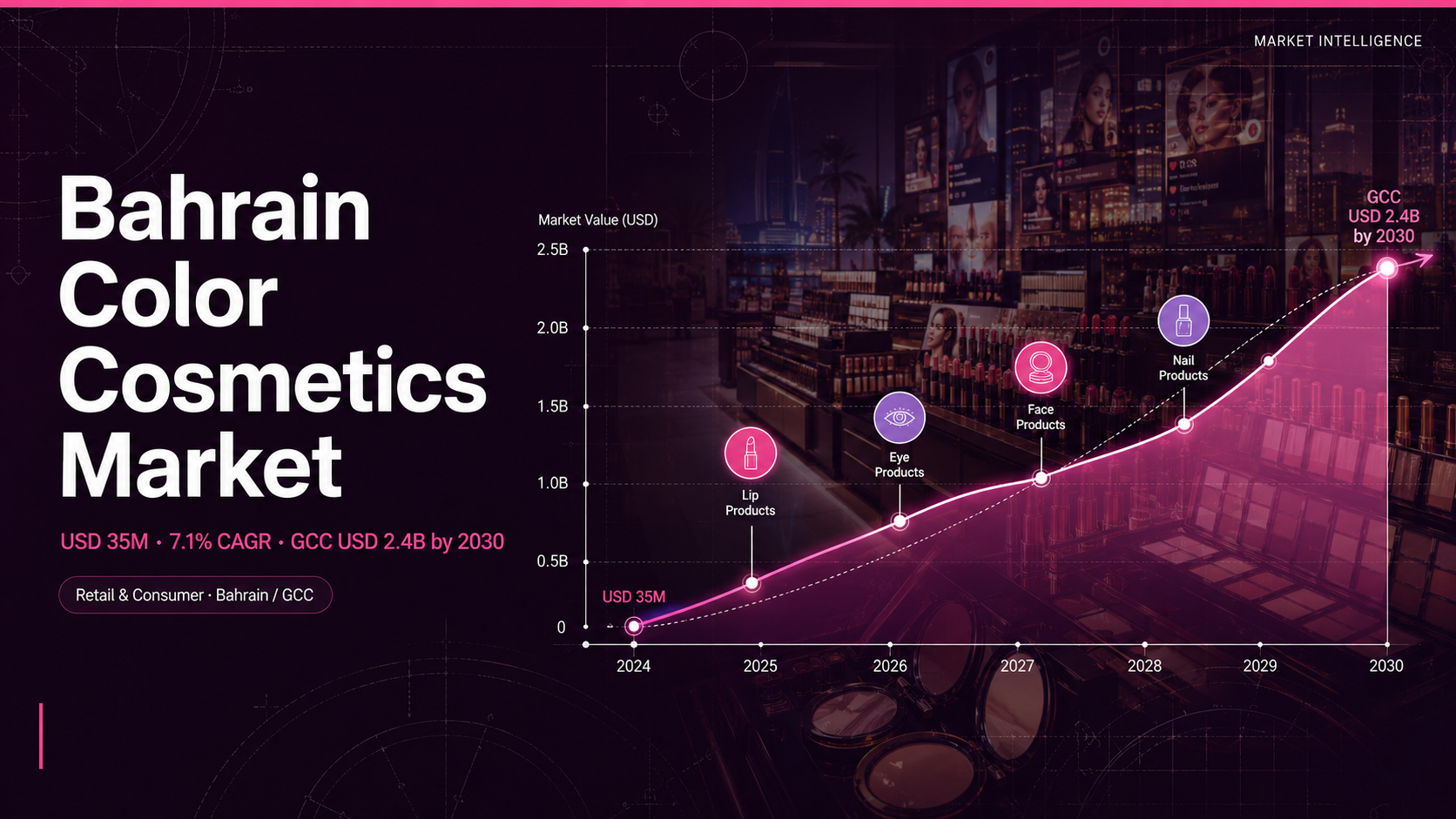
Bahrain's beauty sector is smaller in absolute scale than its Gulf neighbors, but the forces shaping it make it one of the most strategically active color cosmetics arenas in the region. The market is valued at USD 35 million in 2024, nested within a GCC color cosmetics sector worth USD 1,501.2 million in 2023 and growing at a 7.1% CAGR toward 2030. For segment-level data on competitors, distribution channels, and demand drivers, see the Bahrain Color Cosmetics Market Report. This analysis is published by Ken Research, a leading market intelligence firm covering consumer and retail sectors across the Middle East and GCC.
This analysis is based on Ken Research market modelling, operator retail disclosures, Bahrain tourism and economic indicators, GCC regulatory compliance data, and beauty-sector estimates.
USD 35 Million in a USD 1.5 Billion Regional Sector: Why Bahrain's Scale Understates Its Strategic Value
Bahrain's share of GCC color cosmetics revenue looks modest in percentage terms, but the kingdom's high per-capita income, dense urban retail concentration in Manama and Muharraq, and its role as a cross-border tourism hub give it influence over brand entry decisions that its absolute size does not fully capture. The market stands at USD 35 million in 2024, sitting inside a GCC sector valued at USD 1,501.2 million that is on a confirmed trajectory toward USD 2,415.7 million by 2030. Brands exploring entry across the Gulf corridor consistently treat Bahrain as a controlled pilot environment before committing to broader regional rollout, partly because its concentrated retail footprint allows for faster feedback cycles than larger markets; the regional competitive structure framing those decisions is detailed in the GCC Color Cosmetics Market analysis.
- Market Size (2024): Bahrain color cosmetics valued at USD 35 million
- GCC Context (2023): Regional sector at USD 1,501.2 million, forecast to reach USD 2,415.7 million by 2030
- Regional CAGR: GCC color cosmetics growing at 7.1% CAGR through 2030
- Competitive Field: Over 150 brands competing in Bahrain, with top 5 holding only 35% collective share
Tourism Revenues Up 27% and GDP Per Capita at BHD 25,000: The Economic Engine Powering Bahrain Beauty Demand
Bahrain's color cosmetics growth is not purely a consumer sentiment story: it is anchored in measurable economic expansion that is pulling discretionary beauty spending upward across both resident and visitor segments. GDP per capita is projected at BHD 25,000, fueling premiumization as consumers allocate more wallet share toward higher-value formulations, prestige-tier color cosmetics, and branded specialty retail purchases. Tourism revenues rose 27% between 2022 and 2025, bringing fresh consumer traffic into mall beauty counters and duty-free corridors that amplify color cosmetics sell-through well beyond what domestic demand alone would sustain. Brands benchmarking premiumization trajectories and tourism-linked beauty demand across the broader Gulf should review the Saudi Arabia Beauty and Personal Care Market, where the same macro forces are scaling at a parallel pace across a larger consumer base.
Tourism is not a peripheral contributor to Bahrain's beauty retail cycle: it anchors footfall in the specialty retail and modern trade channels where color cosmetics conversion rates are highest. The sector contributes 7% of Bahrain's GDP, and the government has set a visitor target of 14.1 million arrivals by 2026, a volume that sustains color cosmetics demand across travel retail formats, experiential beauty counters in luxury malls, and duty-free beauty destinations. Operators building Bahrain distribution and channel strategies should map retail footfall patterns using the Bahrain Retail Market analysis alongside beauty-specific demand curves to size channel opportunities accurately.
- GDP Per Capita: Projected at BHD 25,000, underpinning premiumization and higher-tier color cosmetics spending
- Tourism Revenue Growth: Rose 27% between 2022 and 2025, expanding beauty retail footfall in malls and duty-free
- Tourism GDP Contribution: Sector contributes 7% of national GDP
- Visitor Target: Government targeting 14.1 million visitors by 2026, sustaining color cosmetics demand in travel retail channels
Want segment-level data on the Bahrain beauty market before committing to a full report? Download Sample Report to preview competitive benchmarking, consumer behavior breakdowns, and distribution channel forecasts at no cost.
How Does a Market Where 80% of Beauty Purchases Begin on Social Media Actually Function for Operators?
The most consequential structural shift in Bahrain's color cosmetics landscape is not a new product category or a regulatory development: it is the near-complete migration of purchase influence from physical retail discovery to social platforms. Over 80% of beauty purchases in Bahrain are influenced by Instagram, Snapchat, and TikTok, and more than 60% of the population actively researches beauty products online before any in-store decision is made. This digital-first discovery dynamic helps explain why the competitive field has expanded to more than 150 brands competing simultaneously: the physical shelf space constraint that historically capped competitive density in small markets has dissolved into a scalable digital shelf, while the effective barrier to brand awareness has shifted from retail placement fees to content velocity, influencer credibility, and platform-native visual storytelling. Operators benchmarking their halal product positioning and digital communication strategies should review the GCC Halal Cosmetics Market for the certification and consumer communication frameworks gaining traction across Gulf digital channels in 2025.
- Social Media Purchase Influence: Over 80% of Bahrain beauty purchases influenced by Instagram, Snapchat, and TikTok
- Online Research Behavior: Over 60% of the population actively seeks product information online before any in-store purchase
- Competitive Field: 150+ brands competing simultaneously, with top 5 holding only 35% collective share
- 2025 New Entrants via Sephora: Ulta Beauty, E.l.f. Cosmetics, and Fenty Beauty entered the GCC via Sephora in 2025, intensifying digital-channel competition
Halal Beauty Projected at USD 118 Billion by 2028: What Regulatory Timelines Mean for Bahrain Market Planners
Compliance friction is a market entry cost that operators consistently underestimate when modeling Bahrain color cosmetics expansion economics. GCC regulatory standards GSO 1943:2024 covering product safety and GSO 2528:2024 governing permissible claims apply across all member states, but there is no unified GCC-wide registration pathway: each of the 6 GCC member states requires a separate product notification submission. In Bahrain specifically, approval timelines average approximately 4 months per product, and the competitive field, where the top 5 brands hold only 35% of market share collectively, means smaller challenger brands navigate the same regulatory queue as multinationals with a fraction of the dedicated compliance resources. Brands assessing how comparable regulatory friction plays out in neighboring Gulf markets should review the Kuwait Color Cosmetics Market for a direct GCC peer comparison on product approval timelines and competitive positioning.
Halal beauty is not a niche positioning play in Bahrain: it is a structural growth vector accelerating across all Gulf consumer segments. The global halal beauty market is forecast to reach USD 118 billion by 2028, Bahrain's Muslim-majority consumer base creates immediate addressable demand for ingredient-compliant certified formulations, and the 7.1% CAGR projected for the GCC color cosmetics sector through 2030 is partly driven by consumer preference migration toward compliant products. Brands that integrate halal certification from the product development stage rather than pursuing it as a post-launch exercise can compress effective time-to-market against that approximately 4-month per-product notification baseline.
- Regulatory Standards: GSO 1943:2024 and GSO 2528:2024 apply across all 6 GCC member states, each requiring a separate notification
- Approval Timeline: Average 4 months per product notification in Bahrain
- Market Concentration: Top 5 brands hold only 35% collective share in Bahrain
- Halal Market Scale: Global halal beauty forecast at USD 118 billion by 2028
Ready to map competitive white space and regulatory entry timelines for your Bahrain color cosmetics strategy? Access the full Bahrain Color Cosmetics Market Report for segment forecasts, player benchmarking, and channel-level demand data.
Conclusion
The Bahrain color cosmetics market at USD 35 million in 2024 carries structural dynamics that its current scale does not fully express. A GCC regional sector growing at 7.1% CAGR toward USD 2,415.7 million by 2030, combined with rising per-capita incomes, accelerating tourism arrivals, and social-media-driven purchase influence exceeding 80% of buying decisions, creates compounding tailwinds for brands that enter with both commercial speed and regulatory preparedness.
The operational discipline required is equally well-defined: navigate a 4-month per-product approval cycle across 6 separate GCC member states, build halal certification into the development cycle from the outset, and compete in a field of more than 150 brands where no single player yet commands pricing authority. Full segment forecasts, competitive benchmarking, and channel-level demand data are available in the Bahrain Color Cosmetics Market Report published by Ken Research.
Frequently Asked Questions
Q1: What is the current size of the Bahrain color cosmetics market and how does it compare to the GCC?
The Bahrain color cosmetics market is valued at USD 35 million in 2024 according to Ken Research modelling. It sits within a GCC color cosmetics sector valued at USD 1,501.2 million in 2023, growing at a 7.1% CAGR toward 2030. Bahrain's strategic importance to that regional growth story exceeds its proportional size because of its tourism gateway role, high-income consumer base, and established position as a preferred brand piloting environment before broader GCC rollout.
Q2: What is driving color cosmetics demand growth in Bahrain?
Three converging forces are driving Bahrain color cosmetics demand. First, rising disposable incomes with GDP per capita projected at BHD 25,000 are fueling premiumization and higher-value brand adoption. Second, social media purchase influence exceeding 80% on Instagram, Snapchat, and TikTok is expanding brand discovery and compressing consumer switching costs. Third, tourism revenues rising 27% between 2022 and 2025 are sustaining footfall in the specialty retail and modern trade channels where color cosmetics conversions are highest.
Q3: Who are the key competitors and how concentrated is the Bahrain color cosmetics market?
The Bahrain color cosmetics market is highly fragmented: more than 150 brands compete simultaneously, yet the top 5 players collectively hold only 35% of market share. Key players include L'Oreal Middle East, Estee Lauder Middle East, Coty Inc., Huda Beauty, Sephora Middle East, Chalhoub Group Beauty Division, KIKO Milano, and INGLOT Cosmetics. For a comparable competitive structure analysis in a neighboring GCC market, see the UAE Color Cosmetics Market.
Q4: What regulatory standards apply to color cosmetics products in Bahrain?
Color cosmetics in Bahrain are governed by GSO 1943:2024 covering product safety and GSO 2528:2024 governing permissible claims. There is no unified GCC-wide registration pathway: brands must file separate notifications in each of the 6 GCC member states. In Bahrain, approval timelines average approximately 4 months per product, and the fragmented market, where the top 5 brands hold only 35% collective share, means smaller operators face the same regulatory queue as multinationals with fewer compliance resources available.
Q5: How significant is the halal beauty opportunity for brands operating in Bahrain?
The halal beauty opportunity in Bahrain is both immediate and structurally large. The global halal beauty market is forecast to reach USD 118 billion by 2028, and Bahrain's Muslim-majority consumer base creates direct addressable demand for certified color cosmetics formulations across all product categories. The 7.1% CAGR projected for the GCC color cosmetics sector through 2030 is partly driven by consumer preference migration toward ingredient-compliant products, and brands integrating halal certification from the development stage can compress effective time-to-market against the approximately 4-month per-product notification timeline. For halal beauty competitive dynamics across the wider Middle East, see the Middle East Beauty and Personal Care Market.


Comments
Post a Comment