GCC Medical Telepresence Robots Market Crosses $85M : Ken Research Tracks 18% CAGR Through 2031
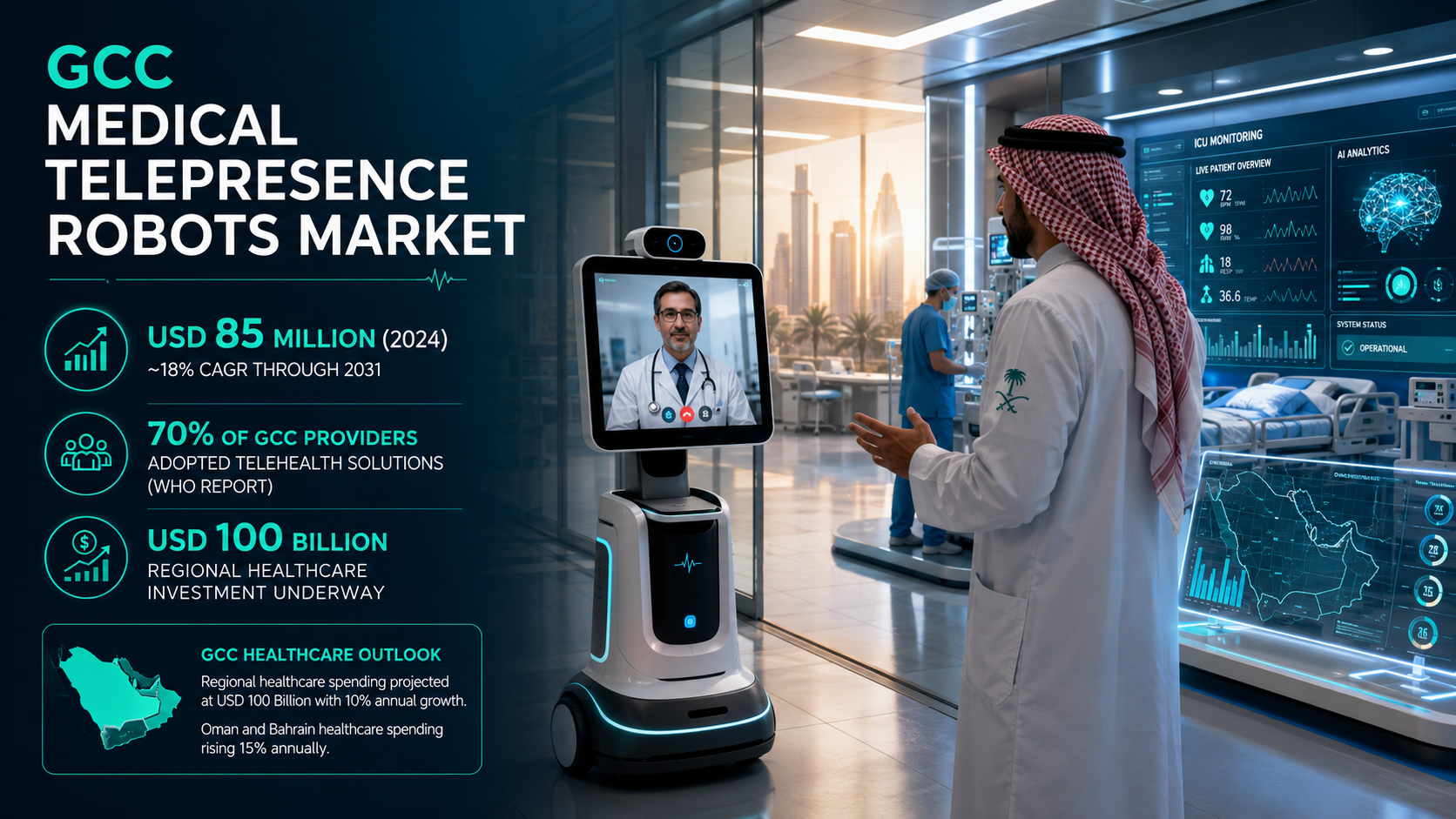
GCC Medical Telepresence Robots Market Hits $85M, 18% CAGR Through 2031 | Ken Research
Executive Summary
The GCC Medical Telepresence Robots Market is valued at USD 85 million in 2024, projected to reach approximately USD 260 million by 2031, expanding at a compound annual growth rate of approximately 18% over the forecast period. This trajectory is underpinned by a fundamental structural shift in GCC healthcare delivery, where 70% of regional healthcare providers have already adopted telehealth solutions, according to WHO data, and where governments are committing to a USD 100 billion regional healthcare expenditure agenda growing at 10% annually. The average telepresence robot unit carries a cost exceeding USD 50,000, yet procurement volumes are accelerating, signaling that ROI calculations across ICUs, specialist consultations, and remote patient monitoring workflows are increasingly favorable.
Key Takeaways
- GCC medical telepresence robots market valued at USD 85 million in 2024, growing at ~18% CAGR through 2031
- 70% of GCC healthcare providers adopted telehealth solutions, creating built-in demand infrastructure for robotic deployment
- GCC healthcare spending projected to reach USD 100 billion regionally, growing at 10% annually, fueling capital equipment procurement
- Telehealth services themselves are expanding at 20% per year across the GCC, serving as the primary adoption accelerant
- Saudi Arabia's 2020 Practice of Telemedicine Rules established the regulatory framework enabling licensed robot-assisted consultations
- Oman and Bahrain healthcare budgets are expanding at 15% annually, extending telepresence adoption beyond UAE and Saudi Arabia
- Average telepresence robot cost exceeds USD 50,000, yet procurement is rising as hospital networks scale tele-ICU and specialist access programs
Market At A Glance
- Market Size (2024): USD 85 million
- Forecast Size (2031): ~USD 260 million
- CAGR: ~18%
- Base Year: 2024
- Forecast Period: 2025-2031
- Region: Gulf Cooperation Council (Saudi Arabia, UAE, Qatar, Kuwait, Oman, Bahrain)
- Sector: Healthcare / Medical Devices
- Key Segments: Mobile Telepresence Robots, Stationary Robots, Hybrid/Semi-Autonomous Robots; Tele-ICU, Remote Patient Monitoring, Teleconsultation
Telehealth Infrastructure Is the Foundation, Not the Future
The GCC's telepresence robot growth story cannot be decoupled from its telehealth infrastructure trajectory. A 30% rise in telehealth consultations occurred between 2020 and the present, creating a proven demand signal that hospital procurement committees are now translating into robotics budgets. With USD 1.5 billion invested in healthcare technology across the region and a projected 25% improvement in operational efficiency from robotic deployments, the ROI case is compelling. Stakeholders tracking broader healthcare digitalization trends should also examine the UAE Preventive Healthcare Market and the Saudi Arabia Healthcare Diagnostics and Imaging Market, which represent adjacent infrastructure layers feeding into this robotic deployment wave.
- Telehealth consultations rose 30% between 2020 and current year, validating physician and patient acceptance of remote care modalities
- USD 1.5 billion invested in GCC healthcare technology, a portion of which is directly channeled toward robotics, AI platforms, and connectivity infrastructure
- Robotic deployments are projected to improve hospital operational efficiency by 25%, reducing overhead on specialist travel, ICU staffing, and consultation response times
- Teleconsultation demand is growing at 20% annually, sustaining the volume of remote physician-patient interactions that telepresence robots facilitate
Regulatory Architecture and Government-Driven Acceleration
Saudi Arabia's 2020 Practice of Telemedicine Rules, issued jointly by the Saudi Commission for Health Specialties and the Ministry of Health, established the region's first comprehensive legal framework for remote consultations, encompassing licensing requirements, patient consent protocols, data privacy obligations, and quality standards. This regulatory clarity has been catalytic: hospitals can now procure telepresence robots with a defined compliance pathway rather than operating in legal ambiguity. Medical device approval timelines of up to 18 months remain a structural friction point, but the broader USD 100 billion GCC healthcare spending commitment signals that procurement pipelines are being built ahead of approvals. For complementary regulatory context, see the KSA Health Insurance Market and the Qatar Health Insurance Market, where reimbursement policy evolution is reshaping how telehealth services are funded.
- Saudi Arabia's 2020 Practice of Telemedicine Rules govern licensing, patient consent, data privacy, and quality standards for all remote consultations including robot-assisted care
- Medical device approval processes run up to 18 months, creating a regulatory lead-time that procurement planners must account for in capex schedules
- GCC governments are channeling 10% annual growth in healthcare expenditure into infrastructure that directly enables high-cost medical device deployment
- Reimbursement policies for telehealth services are evolving across all 6 GCC nations, with payers beginning to recognize robotic-assisted consultations as billable clinical events
Segment Dynamics: Who Is Buying and Why
The GCC medical telepresence robots market segments across product type, clinical application, and end-user cohort, each with distinct adoption drivers. Mobile telepresence robots dominate procurement in large public hospital systems where physician-to-patient ratios remain strained, while hybrid and semi-autonomous variants are gaining traction in private specialty clinics targeting premium patient experiences. Tele-ICU and critical care support represents the highest-value clinical application, as staffing shortages in intensive care create the most acute ROI case for robotic deployment at a unit cost exceeding USD 50,000. Oman and Bahrain healthcare budgets are expanding at 15% annually, extending the addressable market well beyond Saudi Arabia and UAE. The Saudi Arabia Home Health Care Market and the UAE Pharmaceutical Market are adjacent sectors where telepresence robotics is beginning to intersect home-based and ambulatory care.
- Mobile telepresence robots lead procurement in public hospital and health system deployments, addressing specialist-to-patient ratios across large GCC hospital networks
- Tele-ICU and critical care support is the highest-value clinical application, where 24/7 remote intensivist coverage via telepresence robots reduces adverse outcomes and staffing overhead
- Remote patient monitoring and virtual rounds represent the broadest deployment category, compatible with general wards, step-down units, and long-term care settings
- Private hospitals and specialty clinics are procuring hybrid/semi-autonomous robots as premium differentiators for high-paying patient segments across the 6-nation GCC bloc
- Oman and Bahrain, with healthcare spending growing at 15% annually, represent the fastest-emerging procurement markets outside the Saudi Arabia and UAE cores
Competitive Landscape and Technology Positioning
The GCC medical telepresence robots market hosts a range of global and regional competitors, including Teladoc Health (via InTouch Health), OhmniLabs, Ava Robotics, Blue Ocean Robotics, VGo Communications, AXYN Robotique, and Hangzhou Amy Robotics, among others. No single player holds disclosed dominant share in the GCC specifically, but the competitive axis is defined by three parameters: connectivity latency (critical for tele-ICU use cases requiring sub-second response times), AI platform integration (enabling autonomous navigation, fall detection, and ambient monitoring), and after-sales service infrastructure within GCC markets. As the GCC AI in Healthcare Market matures, vendors with stronger AI stack integration will command premium positioning. The Saudi Arabia Hospital Construction Market growth also signals that greenfield hospital deployments will increasingly specify telepresence robot infrastructure at the design stage rather than as retrofit purchases.
- Global vendors including Teladoc Health (InTouch Health), OhmniLabs, Ava Robotics, Blue Ocean Robotics, and VGo Communications are competing for GCC procurement contracts
- AI platform integration, low-latency connectivity, and local service infrastructure are the 3 primary competitive differentiators in GCC hospital procurement evaluations
- Greenfield hospital construction across Saudi Arabia is creating new design-stage specifications for telepresence robots, bypassing retrofit procurement cycles
- The average unit cost exceeding USD 50,000 means GCC procurement decisions are centralized, multi-stakeholder, and multi-year in nature, favoring vendors with strong government relations
Conclusion
The GCC Medical Telepresence Robots Market, valued at USD 85 million in 2024 and projected to reach approximately USD 260 million by 2031, sits at the intersection of the region's three most powerful structural forces: a USD 100 billion healthcare expenditure commitment, a 70% telehealth provider adoption rate, and a regulatory framework newly equipped by Saudi Arabia's 2020 Practice of Telemedicine Rules to license and scale robotic care delivery. The 18% CAGR trajectory is neither speculative nor narrowly dependent on a single driver. It reflects the convergence of government policy, hospital infrastructure investment, AI technology readiness, and a chronic specialist-to-population gap across all 6 GCC nations. Stakeholders exploring the broader GCC health technology ecosystem should also review the Middle East Speech Therapy Services Market, the GCC Longevity and General Wellness Supplements Market, and the Nigeria Digital Health and Telemedicine Market for comparative emerging-market context.
Ken Research Finds
- GCC medical telepresence robots market reached USD 85 million in 2024, with a projected ~18% CAGR to approximately USD 260 million by 2031
- 70% of GCC healthcare providers have already adopted telehealth solutions, establishing the demand foundation for robot-assisted care at scale
- Telehealth consultation volumes rose 30% since 2020, with teleconsultation services growing at 20% annually across GCC nations
- GCC regional healthcare expenditure is projected to reach USD 100 billion, growing at 10% annually, with medical device procurement as a key capital deployment channel
- Saudi Arabia's 2020 Practice of Telemedicine Rules provide the region's clearest regulatory pathway for licensed robot-assisted physician consultations
- Medical device regulatory approval timelines extend up to 18 months, requiring procurement planning 2+ years ahead of deployment targets
- Oman and Bahrain healthcare spending is growing at 15% annually, expanding the addressable GCC telepresence robot market beyond the Saudi Arabia and UAE duopoly
- Average telepresence robot unit cost exceeds USD 50,000, positioning GCC hospital networks as high-value, centralized procurement targets for global vendors
Frequently Asked Questions
Q1: What is the current size of the GCC Medical Telepresence Robots Market and what drives its growth?
The market is valued at USD 85 million in 2024, growing at approximately 18% CAGR toward a projected USD 260 million by 2031. Growth is driven by 70% telehealth adoption among GCC healthcare providers, a 30% rise in telehealth consultations since 2020, and USD 1.5 billion in regional healthcare technology investment, all converging to make robotic-assisted care economically and clinically viable at scale.
Q2: Which GCC countries are leading adoption of medical telepresence robots?
Saudi Arabia and the UAE are the primary procurement hubs, supported by Saudi Arabia's 2020 Practice of Telemedicine Rules regulatory framework and the UAE's USD 1.5 billion+ healthcare technology investment agenda. However, Oman and Bahrain are emerging rapidly, with healthcare budgets growing at 15% annually. Qatar, with its own health insurance market expanding to support teleconsultation reimbursement, is also a growing procurement market across all 6 GCC nations.
Q3: What are the main clinical applications for telepresence robots in GCC hospitals?
Tele-ICU and critical care support represent the highest-value application, where 24/7 remote intensivist coverage via robots addresses GCC's specialist-to-patient ratio gap. Remote patient monitoring and virtual rounds account for the broadest deployment volume, while teleconsultation and specialist access programs, growing at 20% annually, are the fastest-expanding use case. Home healthcare applications are also emerging, particularly as GCC healthcare budgets shift 10% annually toward community-based care models.
Q4: What regulatory requirements govern medical telepresence robot procurement in the GCC?
Saudi Arabia's 2020 Practice of Telemedicine Rules, issued by the Saudi Commission for Health Specialties and Ministry of Health, is the region's benchmark regulation, covering licensing, patient consent, data privacy, and quality standards. Medical device approvals across the GCC can take up to 18 months, requiring procurement planning at least 2 years before targeted deployment. Reimbursement policies are evolving across all 6 GCC nations, with payers increasingly recognizing robot-assisted consultations as billable clinical events within health insurance frameworks.
Q5: How does the cost of telepresence robots affect GCC market adoption?
At an average unit cost exceeding USD 50,000, telepresence robots represent significant capital expenditure that is justified by the 25% improvement in hospital operational efficiency projected from robotic deployments. GCC governments and hospital networks, operating within a USD 100 billion regional healthcare expenditure framework growing at 10% annually, treat this as strategic infrastructure rather than discretionary spend. The ROI case is strongest in tele-ICU settings, where robotic coverage reduces adverse outcomes and specialist travel costs, making the USD 50,000+ investment per unit economically rational within 2-3 years of deployment.


Comments
Post a Comment