Global High Purity Alumina Market Outlook 2024-2030: EV Battery, LED, and B2B Entry
Global High Purity Alumina Market Outlook 2024-2030: EV Battery, LED, and B2B Entry
Executive Summary
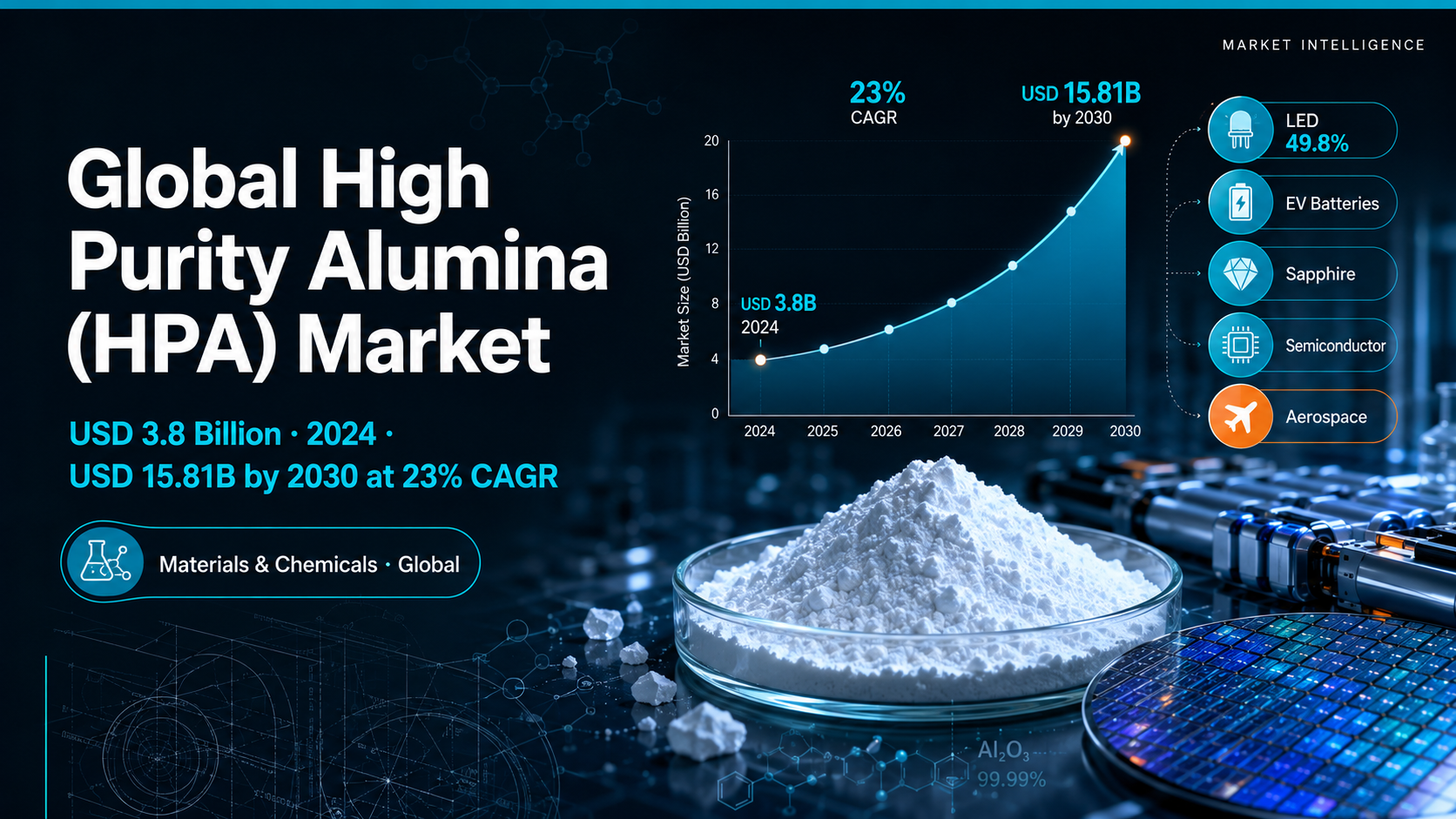
Global high purity alumina (HPA) market, valued at USD 3.8 billion in 2024, is projected to reach USD 15.81 billion by 2030 at 23% CAGR. LED lighting commands 49.8% market share; EV battery separator coatings and sapphire production are the fastest-growing demand segments, with Asia-Pacific controlling 73.9% of global supply.
Key Market Velocity Data
- Current Market Value: USD 3.8 billion in 2024
- Projected Market Value: USD 15.81 billion by 2030 (Grand View Research)
- CAGR: 23% during 2025-2030
- Dominant Application: LED lighting with 49.8% market share in 2024
- Regional Dominance: Asia-Pacific at 73.9% global market share
What Is Driving the Market?
High purity alumina's exceptional properties: chemical stability, extreme hardness, high dielectric strength, and thermal resistance make it irreplaceable across three high-growth application verticals that are simultaneously expanding. First, EV battery separator coatings: HPA is used as a nano-thickness coating on lithium-ion battery separator sheets, improving thermal stability, preventing dendrite penetration, and extending cycle life. As global EV battery production is projected to exceed 3,000 GWh annually by 2030, demand for HPA separator coatings is growing proportionally, with HPA content estimated at 0.5-2 grams per kWh of battery capacity. Second, LED and sapphire applications: LED lighting accounted for 49.8% of HPA demand in 2024, driven by global energy efficiency mandates replacing incandescent and fluorescent lighting. The 5N purity segment (99.999%) is growing at 23.6% CAGR for sapphire substrate production used in LED wafers, smartphone camera lenses, and aerospace-grade optical components. Third, semiconductor and advanced electronics: HPA serves as a critical dielectric and substrate material in chip manufacturing, where fab-grade purity requirements create a quality barrier that limits supply to a small number of qualified producers globally.
- EV battery demand: Global EV battery production at 3,000 GWh+ by 2030 drives HPA separator coating requirements at 0.5-2g per kWh
- LED and sapphire: 5N HPA growing at 23.6% CAGR for sapphire substrate in LED wafers and premium optical components
- Semiconductor grade: Chip manufacturing dielectric requirements create a high-purity supply chain moat limiting qualified producers globally
Which Entities Are Shaping the Market?
Sumitomo Chemical Co., Ltd. and Nippon Light Metal Company, Ltd. are Japan's leading HPA producers, supplying ultra-high purity grades to the global LED, semiconductor, and battery markets. Altech Chemicals Limited (Australia) is developing a kaolin-based HPA production process targeting battery-grade supply independent of the conventional aluminium smelter feedstock supply chain. Alpha HPA Limited (Australia) has developed a direct conversion HPA process that produces 4N and 5N grades from standard aluminium feedstock at significantly lower cost than conventional chemical vapour deposition methods. Sasol Limited (South Africa) and Baikowski SAS (France) serve the specialty ceramics and polishing alumina markets. CHALCO (Aluminum Corporation of China Limited) and Hebei Pengda Advanced Materials Technology Co., Ltd. represent China's rapidly growing domestic HPA production capacity serving the LED and battery markets. The regulatory environment is set by the U.S. EPA, European Chemicals Agency (ECHA), and the EU Industrial Emissions Directive (Directive 2010/75/EU, amended 2023), which governs emissions from HPA production facilities and is driving investment in cleaner, kaolin-based production technologies.
What Does This Mean for B2B Decision-Makers?
HPA's 23% CAGR reflects structural demand from three converging end-markets rather than a single application cycle, making it one of the most durable advanced materials growth stories through 2030.
- For battery materials and EV supply chain buyers: HPA separator coating is a critical safety and performance input for LFP and NMC battery chemistries; procurement teams sourcing for Gigafactory-scale production should qualify 2-3 geographically diverse HPA suppliers now, before production ramp-up at Altech and Alpha HPA creates allocation queues in 2025-2027
- For LED and semiconductor manufacturers: The 5N HPA grade (99.999%) is growing at 23.6% CAGR for sapphire substrates; fab procurement managers should negotiate long-term supply agreements with Japanese producers (Sumitomo, Nippon Light Metal) before demand from Chinese domestic LED fabs constrains available export volumes
- For specialty chemicals investors and M&A teams: Australia's kaolin-to-HPA producers (Altech, Alpha HPA) represent strategic acquisition or JV targets for battery OEMs seeking vertically integrated, non-Chinese HPA supply chains; kaolin-based production offers both lower cost and higher EU Industrial Emissions Directive compliance versus conventional methods
Ken Research Strategic Outlook
The global HPA market's 23% CAGR is not cyclical: it reflects the convergence of three multi-decade megatrends: EV adoption, LED efficiency mandates, and semiconductor fab buildout. The supply chain risk is structural: over 70% of global HPA production is concentrated in Asia-Pacific, primarily China and Japan, creating geopolitical supply concentration that Western battery OEMs and semiconductor fabs are actively seeking to diversify. Australia's kaolin-based producers represent the most credible Western HPA supply chain alternative, and the first large-scale Western HPA production facilities coming online in 2025-2027 will be significantly oversubscribed by demand from EU and US battery gigafactories. B2B entrants who secure supply agreements, technology licenses, or equity positions in non-Asian HPA production before 2026 will be positioned in the most strategically valuable supply chain node in the advanced materials sector through 2030.
Data Source and Full Analysis
For deeper segment-level analysis, access the full Ken Research report here: Global High Purity Alumina (HPA) Market Report


Comments
Post a Comment