Global Rice Market 2025-2030: USD 320 Bn Growing at 2.6% CAGR
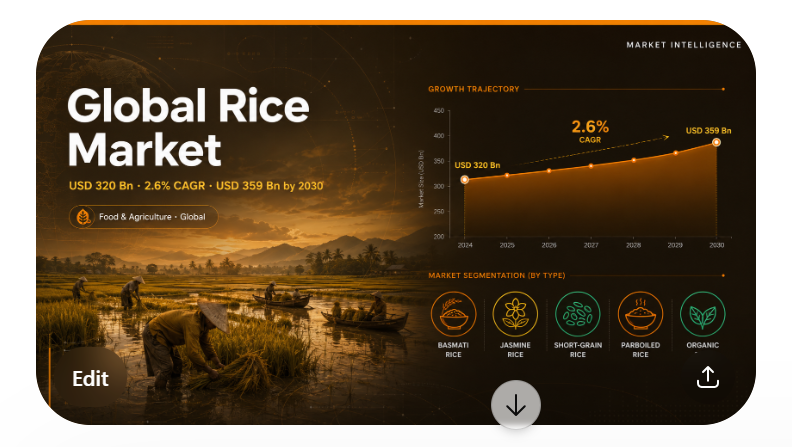
Global Rice Market 2025-2030: USD 320 Bn Growing at 2.6% CAGR
Executive Summary
The global rice market reached USD 320 billion in 2024, tracking toward USD 359 billion by 2030 at a 2.6% CAGR. A global population projected to reach 8.4 billion, rising food security mandates from governments across Asia and Africa, and agricultural technology improvements in irrigation and yield optimization are sustaining demand growth across premium basmati, parboiled, and organic rice categories.
Key Market Velocity Data
- Current Market Value: USD 320 billion in 2024, making rice the world's second most consumed staple crop by volume
- Projected Market Value: USD 359 billion by 2030, driven by population growth and rising premium rice segment demand
- CAGR: 2.6% during 2025 to 2030, a stable growth rate reflecting rice's role as an essential food security commodity
- Population Driver: Global population projected to reach 8.4 billion, adding hundreds of millions of consumers in rice-dependent regions of South and Southeast Asia and Sub-Saharan Africa
- Primary Growth Catalyst: Government food security programs including India's PM-KISAN scheme providing direct income support to 110 million farmers, sustaining production capacity for global export supply
What Is Driving the Global Rice Market at 2.6% CAGR?
Three structural forces sustain the global rice market's growth trajectory. Rising global population in rice-dependent South Asia, Southeast Asia, and Sub-Saharan Africa is creating demand growth that exceeds supply-side productivity gains. Government food security programs in India, China, and Southeast Asian nations maintain subsidized production incentives that prevent price shocks from disrupting bilateral trade flows. Precision irrigation technology, supported by FAO and IRRI programs, is improving average yield per hectare in major producing regions.
- Premium segment premiumization: Global consumer demand for basmati, jasmine, and organic rice categories is outpacing commodity white rice volume growth, with premium varieties commanding 40 to 200% price premiums over standard long-grain equivalents and driving disproportionate revenue growth for export-oriented producers like KRBL Limited and LT Foods in India
- Climate resilience investment: FAO and IRRI-backed drought-resistant and flood-tolerant rice variety development programs are protecting production in climate-vulnerable regions of Bangladesh, Vietnam, and Eastern Africa, sustaining supply stability in markets that represent significant global consumption volume and bilateral trade flows
- Trade policy dynamics: Import tariffs, export restrictions, and food safety standards imposed by major rice-importing nations create regulatory barriers that advantage established bilateral trade relationships over new market entrant strategies, making existing trade partnership portfolios valuable strategic assets for rice exporters and commodity traders
Which Entities Are Shaping the Competitive Landscape?
The global rice market is shaped by commodity traders and branded consumer rice companies. Olam International (Singapore) operates across the full rice value chain from milling to distribution. Riceland Foods is the largest North American rice miller. KRBL Limited (India Gate) and LT Foods (Daawat) dominate premium basmati exports from India. Tilda leads premium basmati in European consumer markets. SunRice (Ricegrowers Limited) leads the Oceania premium segment. The FAO, IRRI, and USDA govern global standards for rice safety and trade.
- KRBL Limited and LT Foods (India basmati leaders): These Indian exporters command 40 to 200% price premiums over commodity white rice equivalents in global markets, benefiting from Indian government export programs and the GI (Geographical Indication) protection for basmati rice that prevents non-Indian producers from competing on the branded premium basmati positioning
- Olam International (global value chain operator): Olam's presence across rice milling, storage, and distribution in Asia, Africa, and MENA gives it commodity supply flexibility that branded rice companies cannot replicate, enabling commodity arbitrage between major exporting nations and price-sensitive import markets during supply disruptions and crop shortfall years
What Does This Mean for B2B Decision-Makers?
The combination of a stable 2.6% CAGR, premium segment acceleration, and food security policy investment signals that global rice is bifurcating between low-margin commodity trading and high-margin branded premium exports. Companies that build premium rice brand positioning in export markets by 2026 will benefit from the premium-to-commodity price spread that widens as middle-class income growth in key consuming markets drives segment trading up from commodity to branded varieties.
- For commodity traders and rice millers: Olam's vertically integrated model across milling and distribution demonstrates that value chain depth, not just commodity volume, creates durable margin in the USD 320 billion global rice market, as pure commodity traders face persistent margin compression from direct exporter-to-importer relationships
- For agri-food brand investors: KRBL's India Gate and LT Foods' Daawat demonstrate that premium basmati brand equity translates into 40 to 200% price premiums in key import markets, making branded premium rice export businesses attractively positioned at the intersection of commodity staple volume and consumer brand premium economics
- For food security program managers and NGOs: FAO and IRRI climate-resilient variety adoption programs protect the supply stability of the USD 320 billion global rice base market, with every percentage point of yield improvement in major producing regions translating to billions in preserved supply value that stabilizes food security in import-dependent nations
Ken Research Strategic Outlook
The global rice market's 2.6% CAGR headline masks a two-speed structure. Commodity white rice grows at sub-1% rates as producing nations grapple with land productivity plateaus, while premium basmati, jasmine, and organic segments grow at 6 to 10% annually driven by middle-class trading-up in Asia, Europe, and North America. Ken Research analysis tracks that this premium acceleration will concentrate export market value share in certified premium origin brands, leaving commodity producers dependent on government price support through 2030.
Data Source and Full Analysis
For deeper segment-level analysis, access the full Ken Research report here: Global Rice Market Report


Comments
Post a Comment