MRD Testing Market Crosses $4.3B by 2028 : Ken Research Reveals NGS Reshaping Precision Oncology
MRD Testing Market to Reach $4.3B by 2028: Ken Research Finds NGS Drives Precision Oncology | Ken Research
Executive Summary
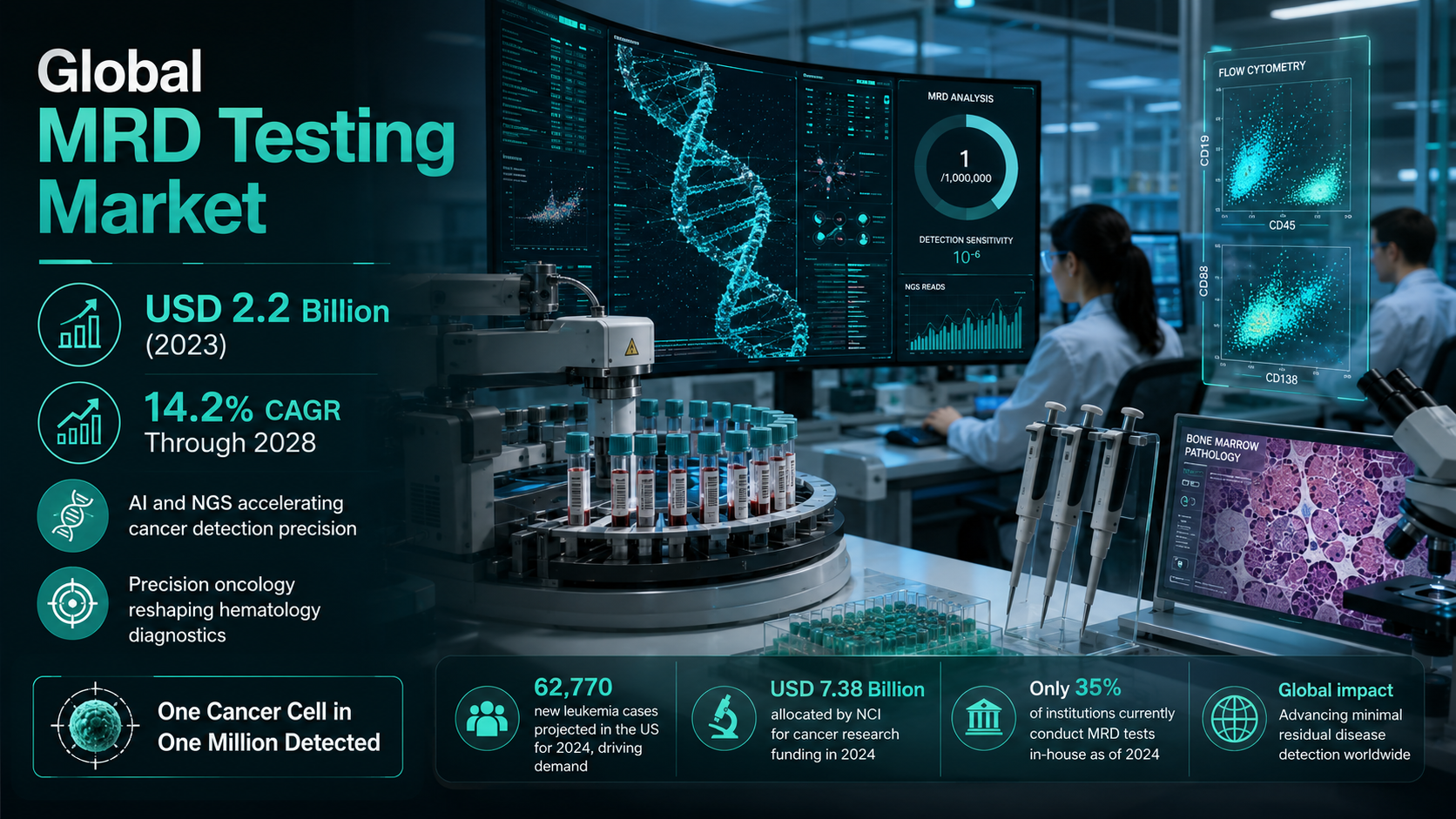
The Global Minimal Residual Disease (MRD) Testing Market, valued at USD 2.2 billion in 2023, is set to reach USD 4.3 billion by 2028, expanding at a compound annual growth rate of 14.2%. Ken Research finds that surging hematologic malignancy incidence, 62,770 new leukemia diagnoses projected in the US alone for 2024, combined with next-generation sequencing (NGS) breakthroughs and USD 7.38 billion in NCI cancer research funding, is fundamentally reshaping how oncologists monitor treatment response and detect cancer recurrence at the sub-microscopic level. The stakes are high: MRD positivity following remission is now a leading predictor of relapse, making ultra-sensitive testing a clinical imperative rather than an optional diagnostic add-on. Yet only 35% of institutions currently conduct MRD tests in-house, signalling a vast adoption gap that defines the market's near-term growth ceiling.
Access the full Global Minimal Residual Disease Testing Market report at Ken Research for detailed competitive benchmarking, segment forecasts, and strategic investment insights.
Key Takeaways
- Market size: USD 2.2 billion (2023) growing to USD 4.3 billion by 2028 at 14.2% CAGR
- Over 62,770 new leukemia cases projected in the US in 2024, alongside 80,000+ new non-Hodgkin lymphoma diagnoses, driving sustained test demand
- NCI allocated USD 7.38 billion for cancer research in 2024; U.S. Cancer Moonshot added USD 150 million in dedicated 2024 funding
- PCR remains the dominant product segment; NGS is the fastest-growing technology segment
- North America leads regional adoption; Asia-Pacific is the fastest-growing geography
- Only 35% of institutions conduct MRD tests in-house, underscoring significant service-provider opportunity
- Detection sensitivity: 1 cancer cell in 1 million healthy cells via advanced assay platforms
- EU Horizon Europe programme allocated EUR 93.5 billion, including cancer diagnostics research streams
Market At A Glance
- Base Year Value: USD 2.2 billion (2023)
- Forecast Value: USD 4.3 billion (2028)
- CAGR: 14.2% (2023-2028)
- Leading Segment: Polymerase Chain Reaction (PCR)
- Fastest-Growing Technology: Next-Generation Sequencing (NGS)
- Dominant End-User: Hospitals and Specialty Clinics
- Leading Region: North America
- Key Players: Natera, Adaptive Biotechnologies, Invivoscribe, Bio-Rad Laboratories, QIAGEN, Roche Diagnostics, Illumina, Thermo Fisher Scientific
Why MRD Testing Is Becoming the New Standard of Cancer Care
The clinical logic behind MRD testing is straightforward: a patient in morphological remission may still harbour 1 residual cancer cell per 1 million healthy cells. Without ultra-sensitive detection, these surviving cells drive relapse in 30-50% of hematologic cancer patients within five years of treatment. Advanced assay platforms, particularly Invivoscribe's LymphoTrack, now achieve sensitivity thresholds that make this level of detection routine. Across the US, 62,770 new leukemia cases are projected for 2024 alone, creating an expanding pool of patients who require post-treatment MRD monitoring across multiple disease cycles.
- PCR-based MRD testing remains the workhorse of clinical practice, offering speed, standardisation, and proven regulatory acceptance
- Flow cytometry provides multi-parametric immunophenotyping for complex malignancies where molecular markers are ambiguous
- NGS-based approaches are being rapidly adopted for their ability to simultaneously profile hundreds of clonal markers, offering superior sensitivity and broader applicability across solid tumours
- AI-powered interpretation platforms are reducing time-to-result by automating variant calling and residual clone quantification, directly addressing pathologist workload constraints in high-volume centres
- Ken Research finds that Vietnam's expanding medical device and diagnostics sector, including contract research and laboratory services, reflects the broader Asia-Pacific trend of rapid diagnostic infrastructure investment
Technology Landscape: NGS, PCR, and Flow Cytometry in Competition
PCR commands the largest share of MRD testing revenues due to its established clinical workflow, regulatory approval, and broad reimbursement coverage in North American and European markets. However, the technology's clone-specific design limits scalability across heterogeneous cancers. NGS, growing at a premium rate within the 14.2% market CAGR, addresses this limitation by enabling whole-exome and targeted panel approaches that track multiple residual clones simultaneously, making it indispensable in lymphoma and multiple myeloma management. Flow cytometry occupies a critical niche in acute leukemia monitoring at centres with established haematopathology infrastructure. Institutions currently performing all three modalities in-house account for fewer than 35% of the global installed base, meaning the majority of testing volume is still outsourced to centralised reference laboratories.
- NGS-based MRD tests generate sensitivity data down to 10^-6 levels, compared to 10^-4 for standard PCR assays
- Roche Diagnostics, Illumina, and Thermo Fisher Scientific are each investing heavily in clinical-grade NGS library preparation kits targeting oncology MRD workflows
- Natera's expansion into European operations with a Swiss headquarters in 2024 signals escalating competition for the EU reference laboratory segment
- Adaptive Biotechnologies' clonoSEQ platform holds FDA clearance for MRD assessment in multiple myeloma, chronic lymphocytic leukaemia, and B-cell acute lymphoblastic leukaemia
- Ken Research notes that global diagnostics technology innovation parallels advances in adjacent fields such as high-resolution confocal microscopy, which supports the cellular imaging workflows underlying MRD analysis
Funding, Policy, and Regulatory Catalysts Reshaping the Market
Government and supranational funding is a structural accelerant for MRD testing adoption. In 2024, the National Cancer Institute allocated USD 7.38 billion to cancer research, with precision oncology and liquid biopsy diagnostics listed as priority funding categories. The U.S. Cancer Moonshot Programme directed an additional USD 150 million specifically toward next-generation cancer detection initiatives in 2024. At the supranational level, the EU's Horizon Europe programme, backed by a EUR 93.5 billion total budget, has embedded cancer detection and genomics research within its health mission clusters, opening grant pathways for academic MRD platform developers and clinical network validators. China's National Cancer Center Initiative and India's National Health Mission expansion are also creating state-backed demand for MRD-capable laboratory infrastructure. These funding catalysts translate directly into accelerated clinical guideline updates, which in turn increase physician ordering rates and insurance reimbursement coverage. Ken Research finds that the intersection of preventive healthcare investment and oncology diagnostics is similarly visible in markets such as the UAE's fast-growing preventive healthcare sector, where government-led health transformation strategies are broadening laboratory diagnostic uptake.
- FDA's Breakthrough Device Designation pathway has accelerated approval timelines for MRD assays in rare haematologic cancers
- European CE-IVD marking requirements are being updated under the EU IVDR framework, raising the regulatory bar but also providing clearer market access routes for validated platforms
- CMS reimbursement coverage for NGS-based tumour profiling has improved substantially since 2022, reducing payer friction for MRD test adoption in US oncology practice
- Real-world evidence programmes mandated by EMA and FDA as post-market conditions are creating longitudinal MRD data assets that feed back into clinical guideline refinement
Competitive Landscape: Who Is Winning the MRD Race
The global MRD testing competitive landscape features a concentrated group of specialists competing alongside diagnostics giants. Natera, Adaptive Biotechnologies, and Invivoscribe lead the specialist segment with purpose-built MRD platforms, while Roche Diagnostics, QIAGEN, Illumina, and Thermo Fisher Scientific leverage their scale in sequencing reagents and instruments to establish MRD-specific product lines. The combined presence of these players across 5 major and 11 additional competitive entities reflects a maturing market where differentiation increasingly rests on assay sensitivity, turnaround time, bioinformatics capability, and reimbursement access rather than clinical validation alone. North America held the dominant regional position in 2023, with hospital-based MRD programmes concentrated in National Cancer Institute-designated cancer centres. Europe represents the second-largest market, supported by integrated national cancer networks in Germany, France, and the UK. Asia-Pacific is the fastest-growing region, driven by rising cancer incidence, laboratory infrastructure investment, and government health initiatives in China, India, South Korea, and Japan. Ken Research observes that Germany's pharmaceutical and diagnostics market, including the well-established OTC drug sector, reflects the broader European health system maturity that underpins MRD clinical adoption.
- Guardant Health and GRAIL are extending liquid biopsy platforms toward MRD monitoring in solid tumours, broadening the addressable market beyond haematologic cancers
- NeoGenomics operates one of the largest MRD testing laboratory networks in the US, providing outsourced reference services to community oncology practices
- QIAGEN's QIAseq portfolio offers library preparation solutions compatible with both research and clinical MRD workflows, positioning it as an enabling platform rather than a finished assay provider
- Biocartis and Asuragen focus on molecular oncology niches within MRD, including companion diagnostic applications that link test results to targeted therapy eligibility
Conclusion
The Global MRD Testing Market's trajectory from USD 2.2 billion in 2023 to USD 4.3 billion by 2028 at 14.2% CAGR is not a speculative projection; it reflects hard epidemiological, technological, and policy realities. With over 62,770 new leukemia cases projected annually in the US, USD 7.38 billion in NCI funding, and only 35% of institutions currently operating MRD testing in-house, the market's near-term growth is grounded in a structural adoption gap that precision diagnostics companies are uniquely positioned to close. NGS and AI are not peripheral innovations here; they are redefining the clinical utility ceiling of MRD testing and opening the market toward solid tumour applications that could multiply the total addressable opportunity by the early 2030s. Ken Research finds that understanding how medical diagnostics markets like ophthalmic drugs and specialty testing evolve alongside MRD adoption is critical for investors and strategists, as seen in Vietnam's ophthalmic pharmaceutical market and Vietnam's testing and inspection certification sector.
Download the complete Global Minimal Residual Disease Testing Market report from Ken Research to access detailed segment forecasts, competitive benchmarking, and strategic entry frameworks for the global precision oncology diagnostics landscape.
Ken Research Finds
- Ken Research finds that the MRD testing market is entering a structural inflection point as NGS platforms achieve clinical-grade sensitivity of 1 residual cell per 1 million and AI bioinformatics reduce interpretation time by 40-60% in early adopter centres
- Ken Research finds that North America's dominance in MRD testing is reinforced by NCI-designated cancer centres, which drive both clinical adoption and the generation of real-world evidence that accelerates payer coverage decisions
- Ken Research finds that the 65% of institutions still relying on outsourced MRD services represent the most commercially accessible growth segment for reference laboratory operators and diagnostic service companies through 2028
- Ken Research finds that Asia-Pacific's MRD market will see the fastest regional growth through 2028, propelled by rising leukemia and lymphoma incidence, expanding health insurance coverage, and government-backed laboratory modernisation programmes in China, India, and South Korea
- Ken Research observes that diagnostic innovation trends in adjacent healthcare markets, from Middle East clinical services expansion to specialty diagnostics growth in Indonesia, reflect the global pattern of precision medicine investment widening across healthcare systems
Q1: What is the size of the Global MRD Testing Market in 2023 and what is its forecast by 2028?
The Global MRD Testing Market was valued at USD 2.2 billion in 2023 and is forecast to reach USD 4.3 billion by 2028, growing at a CAGR of 14.2% during the forecast period. This growth is driven by rising cancer incidence, with 62,770 new leukemia cases projected in the US in 2024 alone, alongside accelerating adoption of NGS-based testing platforms that achieve 1-in-1-million cancer cell detection sensitivity.
Q2: Which technology segment leads the MRD Testing Market?
PCR (Polymerase Chain Reaction) is the dominant technology segment due to its established clinical workflow, regulatory approval, and broad reimbursement coverage. However, NGS is the fastest-growing segment within the overall 14.2% CAGR, offering sensitivity at 10^-6 levels compared to PCR's 10^-4, and enabling simultaneous monitoring of multiple residual clonal populations, particularly valuable in lymphoma and multiple myeloma management. Flow cytometry remains critical in acute leukemia centres with established haematopathology infrastructure.
Q3: What government funding is driving MRD testing adoption globally?
In 2024, the National Cancer Institute allocated USD 7.38 billion to cancer research, with precision oncology and liquid biopsy diagnostics as priority areas. The U.S. Cancer Moonshot Programme contributed an additional USD 150 million in 2024. At the supranational level, the EU's Horizon Europe programme carries a EUR 93.5 billion total budget, with cancer detection and genomics embedded within its health mission clusters. These funding streams directly translate into updated clinical guidelines and expanded reimbursement coverage, both of which accelerate physician ordering rates for MRD assays.
Q4: Who are the key players in the Global MRD Testing Market?
The market features 5 core specialist players: Natera, Adaptive Biotechnologies, Invivoscribe, Bio-Rad Laboratories, and QIAGEN, alongside 11 additional competitors including Guardant Health, Roche Diagnostics, Sysmex Corporation, ArcherDX, Illumina, GRAIL, Asuragen, Biocartis, NeoGenomics, Thermo Fisher Scientific, and others. Adaptive Biotechnologies' clonoSEQ holds FDA clearance for MRD in 3 major haematologic cancer types. Natera expanded European operations with a Swiss headquarters established in 2024, signalling intensifying competition for the EU reference laboratory segment.
Q5: What is the biggest barrier to MRD testing adoption and how is the market addressing it?
The most significant adoption barrier is institutional infrastructure: only 35% of global institutions currently conduct MRD tests in-house, meaning 65% depend on outsourced reference laboratory services. This gap is being addressed through 3 parallel mechanisms: first, expanded centralised reference networks such as NeoGenomics serving community oncology centres; second, the development of simpler, standardised assay kits by QIAGEN and Thermo Fisher that lower the technical bar for in-house laboratory setup; and third, AI-assisted bioinformatics platforms that reduce the need for specialist bioinformatician oversight, cutting per-test operational costs by an estimated 30-40% at scale.


Comments
Post a Comment