Philippines Dialysis Centre Market Targets 150K Patients at 15.5% CAGR | Ken Research
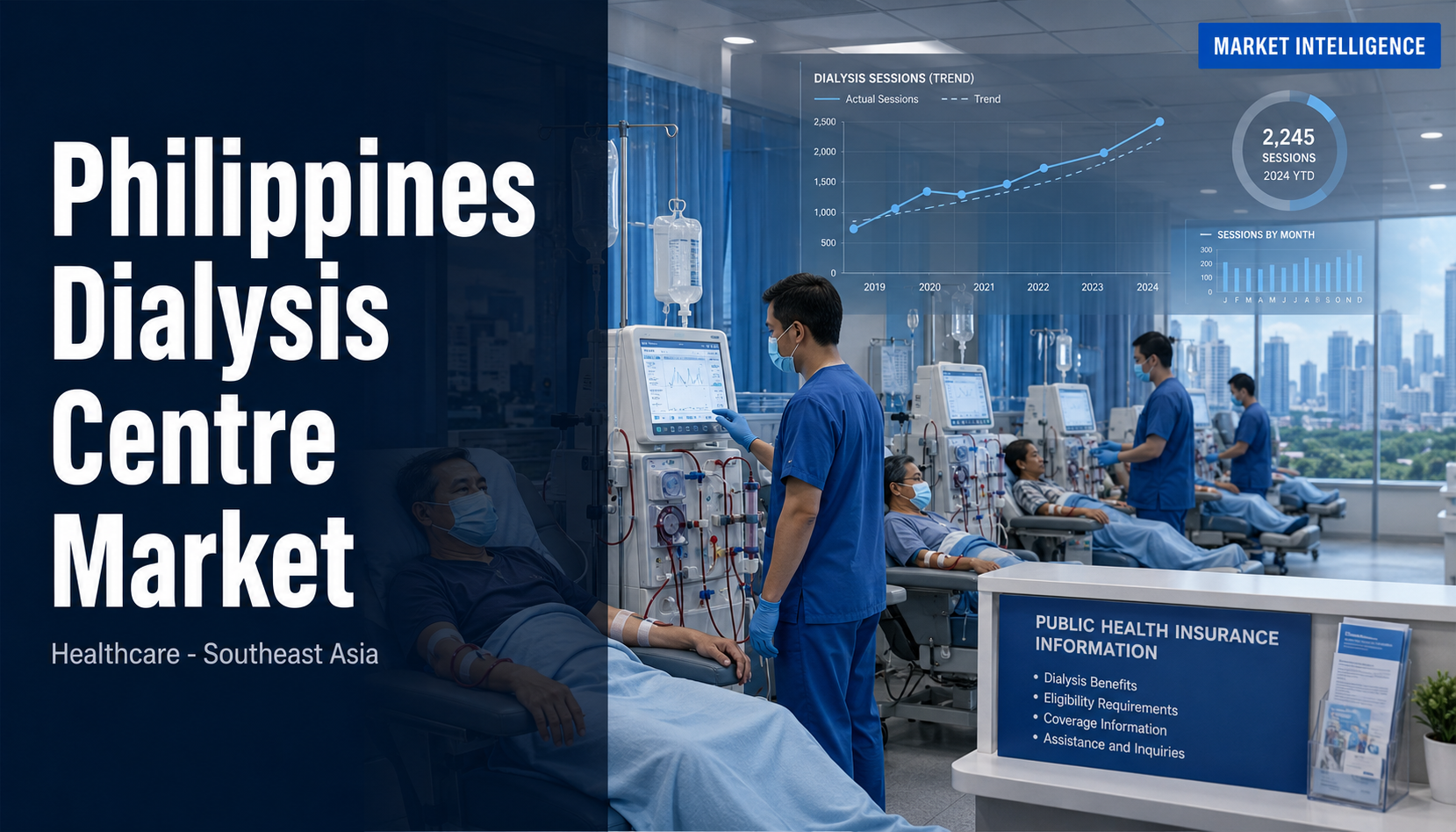
Philippines Dialysis Centre Market Targets 150K Patients at 15.5% CAGR | Ken Research
The Philippines does not have a kidney disease problem. It has a 35.94% CKD prevalence rate among adults, the highest in Southeast Asia, that is converting into a dialysis capacity crisis faster than standalone centres can be built. As per Ken Research market modelling, the Philippines Dialysis Centre market is underpinned by a PhilHealth HD session claims volume that grew at a 15.5% CAGR, reaching 5.1 million sessions by 2024, and dialysis patients are projected to hit 150,000 by 2030. The full forecast, facility-level analysis, and competitive landscape are in the Philippines Dialysis Centre Market Report.
This analysis draws on Ken Research market modelling, PhilHealth benefit package data, Philippine Statistics Authority health surveys, and independent healthcare facility benchmarking.
Standalone Dialysis Centres Hold Majority Share as 5.1 Million Sessions Signal Structural Demand
PhilHealth increased hemodialysis reimbursement to PHP 6,350 per session (effective October 2024), covering up to 156 sessions annually with an annualized ceiling of PHP 1.2 million per patient. Standalone Freestanding Dialysis Centres hold the majority market share per Ken Research analysis, due to faster rollout timelines and lower capital requirements. The market base of PHP 99.5 billion is supported by a patient population growing at 120 ESRD progressions per million annually, roughly 13,000 new ESRD patients per year. Operators benchmarking facility economics will find direct benchmarks in the Philippines Hemodialysis and Peritoneal Dialysis Market, which maps the modality split and cost-per-session economics across facility types.
- Session volume: PhilHealth HD claims reached 5.1 million sessions by 2024, growing at 15.5% CAGR, confirming structural demand acceleration
- Reimbursement floor: PHP 6,350 per session provides a guaranteed revenue floor for operators, with out-of-pocket and private insurance filling the gap for premium centers
- Facility type: Standalone centres dominate by share due to lower capex per chair versus hospital-integrated units in Metro Manila, Cebu, and Davao
CKD at 35.94%: How the Philippines Became the Region's Highest-Prevalence Dialysis Market
The Philippines CKD prevalence of 35.94% is more than double the global rate of 9.1% to 13.4%, creating a patient pipeline no competitor market can match per capita. An elderly population of 10.3 million aged 60+ (representing 9% of total population in 2024) drives new ESRD diagnoses. NephroPlus, Fresenius Kidney Care, B. Braun Avitum Philippines, and DaVita Kidney Care hold dominant private facility shares. The expanded PhilHealth benefit package of 2025 is projected to reduce the unmet treatment gap that currently leaves over 60,000 ESRD patients without regular dialysis access.
- CKD pipeline: 7 million Filipinos are living with CKD today, of whom 120 per million annually progress to ESRD requiring dialysis initiation
- Elderly growth: The 60+ age cohort at 10.3 million in 2024 is the highest-risk demographic and is growing faster than the general population
- Home dialysis gap: Home dialysis adoption below 2% despite 20% patient interest, creating an underserved modality segment for operators investing in home program infrastructure
Philippines dialysis demand is structurally non-cyclical and growing. Download Sample Report to see facility-level forecasts, PhilHealth reimbursement analysis, and competitive benchmarking.
Why Is the Philippines Dialysis Market Growing Faster Than Regional Peers Despite CKD Being a Chronic Condition?
With CKD at 35.94% against a treatment penetration well below disease burden, there is a compressing gap between unmet patient need and available facility chairs. The dialysis patient population grows from 80,000 in 2025 to 150,000 by 2030, requiring the network to scale at equivalent pace. At average cost of approximately PHP 2,500 per session, session revenue alone exceeds PHP 87 billion annually at the 2030 patient count. The Philippines Smart Hospitals Market maps the digital infrastructure investment enabling remote patient monitoring and dialysis scheduling optimization that supports multi-site operator efficiency.
Philippines Dialysis Centre Outlook to 2030: 150,000 Patients and the Regional Expansion Window
The 150,000 patient target by 2030 creates a predictable expansion roadmap. Cebu, Davao, and secondary cities across Luzon, Visayas, and Mindanao are the growth frontier. NKTI anchors the public-sector side while private chains expand via franchise models. PHP 1.2 million annual PhilHealth reimbursement per patient supports facility payback in 3-4 years for well-located standalone centres. For investors mapping the regional buildout, the Philippines SNF-Based Dialysis Market covers the skilled nursing facility integration model that extends dialysis access to patients who cannot self-transport.
- Patient growth: From 80,000 in 2025 to 150,000 by 2030, requiring an estimated 350-400 new dialysis centres to maintain current session availability ratios
- Regional opportunity: Visayas and Mindanao remain underserved relative to patient prevalence, with PhilHealth expansion enabling first-time profitable operations in secondary cities
- Home dialysis upside: Converting even 5% of patients to home peritoneal dialysis would reduce in-centre session demand by 7,500 patients while opening a new product category for home care operators
What Dialysis Operators and Healthcare Investors Must Do Before the 2030 Patient Doubling Closes Entry Windows
The patient doubling from 80,000 to 150,000 by 2030 is a disease progression calculation, not a forecast. Facility decisions in 2026-2027 determine which operators capture the base before consolidation.
- Operators: Secure chair capacity in Visayas and Mindanao now before PhilHealth-driven demand compresses available property at dialysis-suitable locations
- Equipment suppliers: Lock multi-year agreements with the 5 largest private chains before they complete their 2027-2030 expansion sourcing rounds
- Investors: Target standalone centre operators in secondary cities with PHP 1.2 million PhilHealth coverage per patient providing a predictable revenue floor on 3-4 year payback models
The patient pipeline is already identified. The question is chair availability. Philippines Dialysis Centre Market Report from Ken Research covers operator benchmarking, PhilHealth economics, and regional facility gap analysis through 2030.
Conclusion
The Philippines Dialysis Centre market is driven by disease arithmetic. CKD at 35.94% and a patient count doubling by 2030 means the constraint is facility capacity, not demand. Operators establishing regional presence in 2026-2027 will capture the structural growth PhilHealth reimbursement now makes viable. Access the Philippines Dialysis Centre Market Report for the full competitive analysis and forecast through 2030.
Frequently Asked Questions
Q1: What is the size of the Philippines Dialysis Centre Market?
The Philippines Dialysis Centre market base is PHP 99.5 billion per Ken Research, with PhilHealth HD claims at 5.1 million annually growing at 15.5% CAGR. Patient count grows from 80,000 in 2025 to 150,000 by 2030. At PHP 2,500 per session, annual revenue potential exceeds PHP 87 billion at peak patient count.
Q2: Who are the key players in the Philippines Dialysis Centre Market?
NephroPlus, Fresenius Kidney Care, B. Braun Avitum Philippines, DaVita Kidney Care, and Hemotek Renal Center lead private operations. NKTI anchors public-sector provision. Standalone Freestanding Dialysis Centres dominate by facility share per Ken Research estimates. The Philippines Healthcare Service Market contextualizes dialysis within the broader private healthcare operator landscape.
Q3: What is driving growth in the Philippines Dialysis Centre Market?
Growth is driven by CKD at 35.94% prevalence, an elderly population of 10.3 million aged 60+, and PhilHealth reimbursement at PHP 6,350 per session for 156 sessions annually. ESRD progression adds approximately 13,000 new dialysis patients per year.
Q4: How does PhilHealth reimbursement affect the Philippines Dialysis Centre Market?
PHP 6,350 per session (October 2024) provides a guaranteed revenue floor. At 156 sessions annually, PhilHealth covers PHP 1.2 million per patient per year, making secondary city centres viable. The expanded 2025 benefit package accelerates patient access beyond Metro Manila.
Q5: What is the fastest-growing segment in the Philippines Dialysis Centre Market?
Standalone centres are fastest-growing per Ken Research analysis. Home peritoneal dialysis, below 2% adoption despite 20% patient interest, is the largest underserved segment. Regional expansion outside Metro Manila is the primary geographic growth driver through 2030.
Access the Philippines Dialysis Centre Market Report from Ken Research for the full facility-level forecasts and competitive benchmarking.


Comments
Post a Comment