Russia Fintech Cross-Border Payments Market Outlook 2024-2030: Forecast
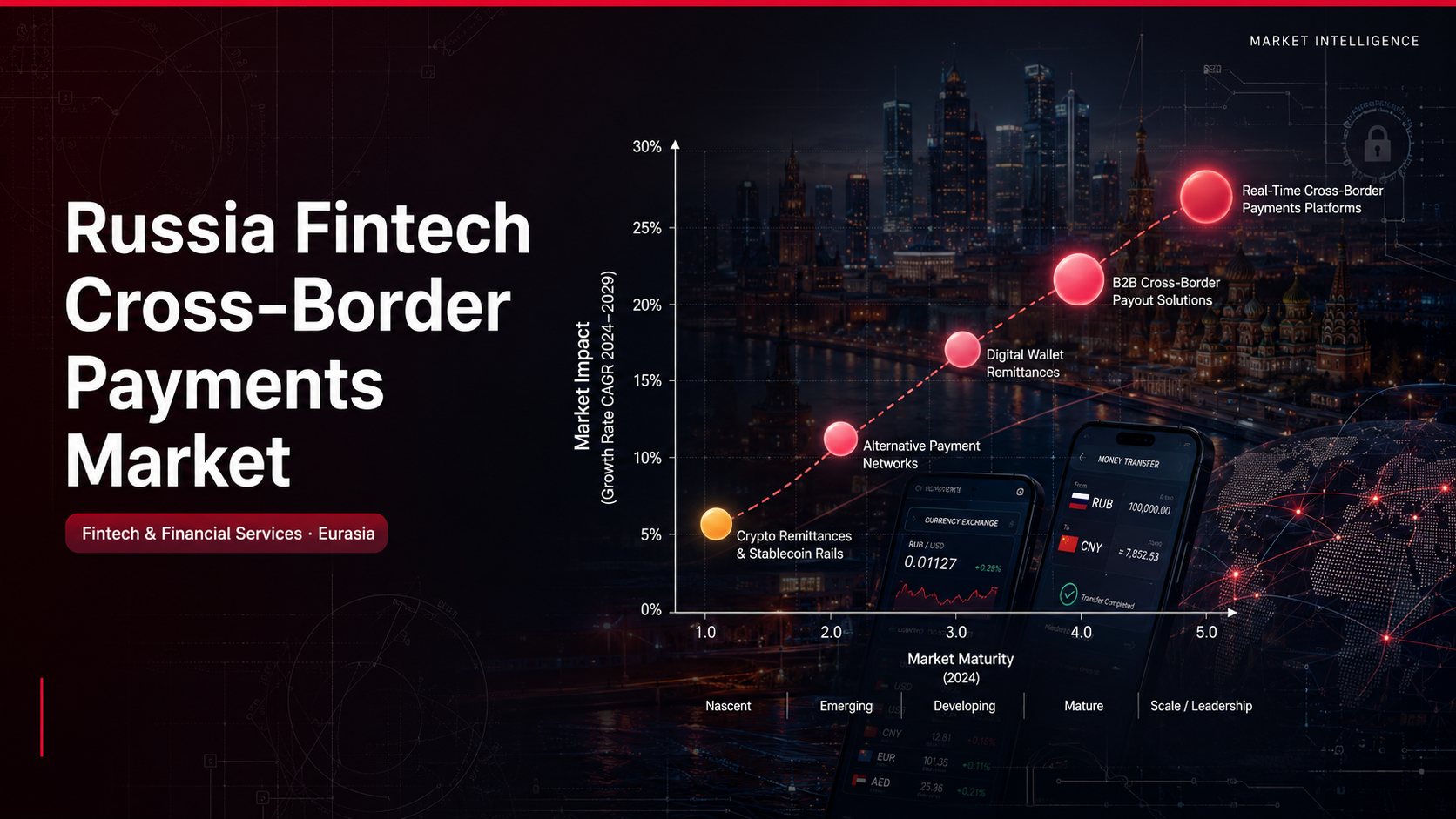
Russia Fintech Cross-Border Payments Market Outlook 2024-2030: Forecast
Executive Summary
Russia's fintech cross-border payments market reached USD 7.5 billion in 2024. One force defines it: sanctions cut Russia off from Western rails, so the market is being rebuilt around domestic systems like SPFS, Mir, and the digital ruble.
Key Market Velocity Data
- Current Market Value: USD 7.5 billion in 2024
- Projected Market Value: approximately USD 17 billion by 2030
- CAGR: about 15% during 2025 to 2030
- Dominant Segment: remittance and payment-processing platforms, consumer-led
- Primary Growth Catalyst: SPFS messaging, Mir adoption, and the digital ruble rollout
What Is Driving the Market?
Sanctions reshaped the rails. The market sits at USD 7.5 billion in 2024 and is projected toward USD 17 billion by 2030 at about 15% CAGR. After Visa and Mastercard withdrew in 2022, Russia scaled domestic alternatives, and digital payments now run about 70% of online transactions. No other major economy has rebuilt its payment infrastructure this fast, and that forced independence is the entire growth story.
Remittances and e-commerce add volume. International remittances are projected near USD 37 billion, and cross-border e-commerce toward USD 60 billion, while the Central Bank has allocated about USD 250 million to fintech support. CIS corridors and trade with friendly nations carry the flows, and trade in national currencies is rising fast. Alternative correspondent networks and local-currency settlement are filling the gap left by SWIFT restrictions, while mobile-first consumers accelerate adoption across the region.
- Sanctions shift: Visa and Mastercard exits in 2022 forced domestic rail buildout
- Digital adoption: digital payments handle about 70% of online transactions
- Remittances: international remittance flows are projected near USD 37 billion
- State support: the Central Bank allocated about USD 250 million to fintech
Which Entities Are Shaping the Market?
State banks anchor the system. Sberbank, VTB, Alfa-Bank, and Raiffeisen drive payment processing, while Tinkoff, Qiwi, Yandex.Money, and WebMoney serve digital wallets and consumer transfers across the USD 7.5 billion market. The National Payment Card System operates Mir as the domestic card standard. Scale, state backing, and sanction-resilience define the leaders, and consolidation around national champions is accelerating.
Infrastructure providers are central. The System for Transfer of Financial Messages, SPFS, replaces SWIFT messaging for cross-border flows, while bilateral links with partner countries extend reach. Payment-processing and remittance platforms lead by type, and individual consumers dominate end-use across the USD 7.5 billion market. Interoperability with friendly-nation systems is the key competitive frontier.
Regulation drives the architecture. The Bank of Russia governs payment systems, the Digital Financial Assets Law frames crypto and tokenized settlement, and AML rules shape compliance. In May 2025, the Central Bank confirmed a successful digital-ruble pilot and a planned large-scale rollout across the USD 7.5 billion market. Policy and infrastructure now move as one.
How Do Segments and Users Split?
Segments and users concentrate demand. Payment processing, remittance services, and currency exchange lead, ahead of digital wallets and gateways. Individual consumers dominate end-use across the USD 7.5 billion market in 2024, followed by SMEs and large corporations. The digital ruble and crypto-settlement rails are the fastest-rising layer. Bank transfers and mobile payments carry the bulk of value, and tokenized cross-border settlement is the high-growth niche.
- By type: payment processing and remittance lead, with digital wallets following
- By user: individual consumers dominate, with SMEs and corporates next
- By method: bank transfers and mobile payments carry most value
- By frontier: digital ruble and crypto settlement grow fastest
What Does This Mean for B2B Decision-Makers?
Build for a parallel financial system. The USD 7.5 billion market grows about 15%, but the durable edge is connecting to SPFS, Mir, and digital-ruble rails rather than Western networks. Players that master friendly-nation interoperability and local-currency settlement will win. Sanctions compliance complexity is the defining operational hurdle for cross-border flows.
Infrastructure and trust are the levers. SPFS connectivity, digital-ruble integration, and AML-compliant corridors separate scaled operators across a USD 7.5 billion market heading toward USD 17 billion. Counterparty and currency risk make robust settlement essential, and partner-country rails are the route to scale.
- For banks: integrate SPFS and digital-ruble rails to secure resilient cross-border settlement
- For fintechs: build remittance and wallet corridors with CIS and friendly-nation partners
- For investors: back infrastructure plays riding a 15% CAGR toward USD 17 billion
- For corporates: adopt local-currency settlement to manage sanctions and currency risk
Ken Research Strategic Outlook
Ken Research sees Russia fintech cross-border payments as a sovereign-rails rebuilding story. The next phase rewards operators connecting SPFS, Mir, the digital ruble, and friendly-nation systems into a resilient parallel network. Expect the USD 7.5 billion market to grow toward USD 17 billion by 2030 as domestic infrastructure and partner corridors deepen across Eurasia.
Data Source and Full Analysis
For deeper segment-level analysis, access the full Ken Research report here: Russia Fintech Cross-Border Payments Market Report


Comments
Post a Comment