USD 50B Ophthalmic Devices Market Faces 2.9B Unmet Vision Cases : Ken Research Maps the 5.5% CAGR Path to 2030
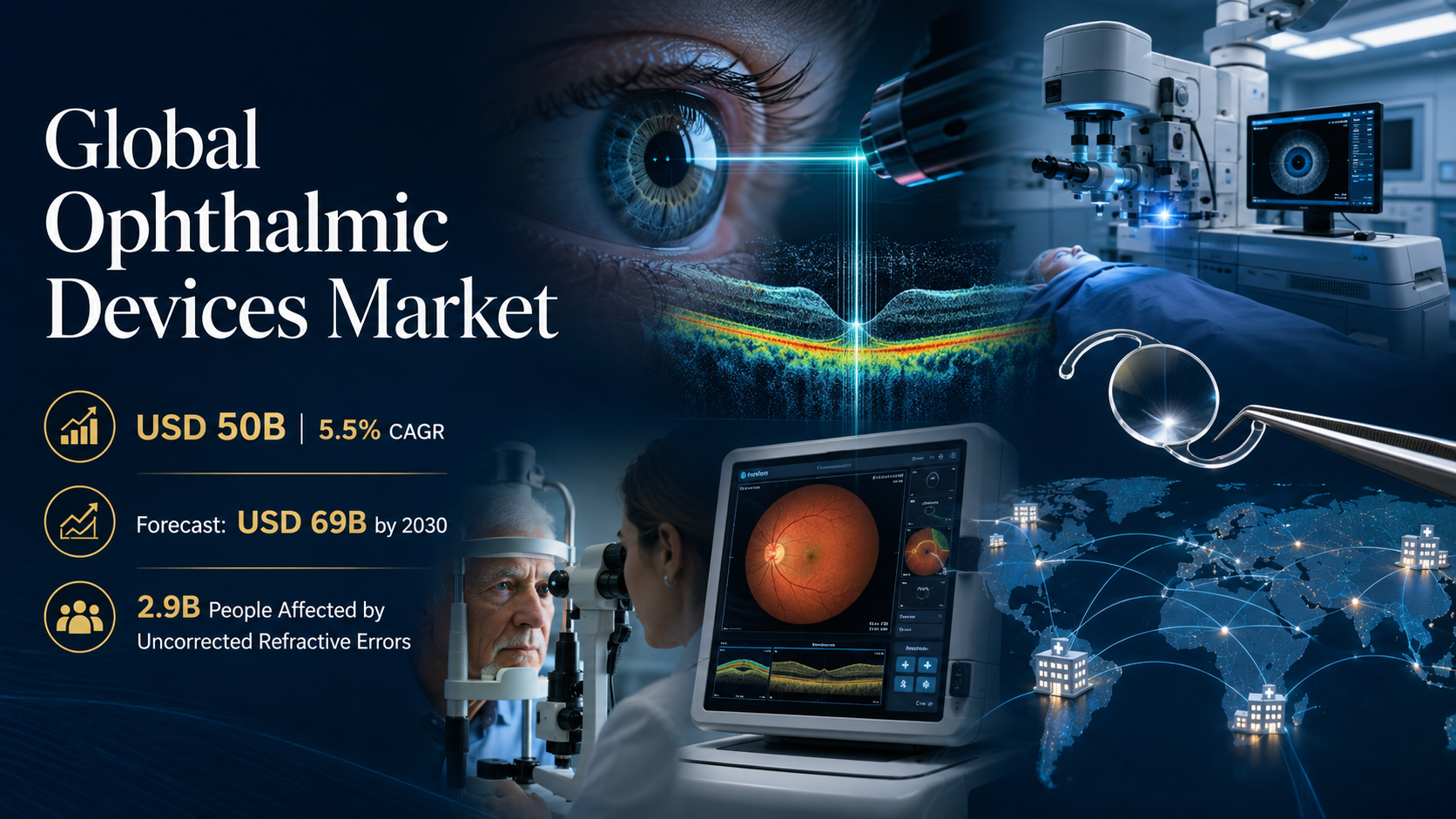
Global Ophthalmic Devices Market Reaches USD 50B as 2.9 Billion Face Uncorrected Vision Loss | Ken Research
Executive Summary
Healthcare procurement leaders face a structural challenge: aging populations are accelerating demand for ophthalmic diagnostics and surgical tools faster than most procurement cycles can absorb. Ken Research values the Global Ophthalmic Devices Market at USD 50 billion in 2024, projected to reach USD 69 billion by 2030 at a 5.5% CAGR. FDA 21 CFR Part 820 regulations and the WHO SPECS 2030 program -- targeting a 40% improvement in global spectacle access -- are reshaping procurement and approval timelines across all regions. Comparable aging-population demand trajectories are analyzed in the UAE Preventive Healthcare Market.
Analyst: Ken Research Market Analysis | Methodology: Ken Research market modelling, regulatory/government data, operator interviews, manufacturer disclosures.
Key Takeaways
- Market Scale (Ken Research, 2024): Global ophthalmic devices market at USD 50 billion, driven by rising cataract, glaucoma, and diabetic retinopathy cases worldwide.
- Growth Trajectory (Ken Research): Projected to reach USD 69 billion by 2030 at 5.5% CAGR, with Asia-Pacific as the fastest-growing region.
- Disease Burden (WHO, 2024): 2.9 billion people globally live with uncorrected refractive errors, sustaining device demand across all market tiers.
- Technology Investment (Ken Research): OCT, laser-assisted surgery, and digital imaging investment projected to exceed USD 12 billion.
- Regulatory Catalyst (FDA/WHO): 2023 QMSR transition rule and WHO SPECS 2030 mandate 40% spectacle access improvement, compressing device certification timelines.
Market At A Glance
Market Size and Growth Trajectory
Ken Research places the global ophthalmic devices market at USD 50 billion (2024), forecast to reach USD 69 billion by 2030 at a 5.5% CAGR (Ken Research). Diagnostic devices hold segment leadership; surgical devices are the fastest-growing sub-category driven by laser and minimally invasive procedure adoption. Hospital procurement accounts for the majority of end-use demand, followed by specialized eye clinic networks. See the Global Confocal Microscope Market and Vietnam Medical Device CRO Market for segment-level procurement comparables.
Rising Global Disease Burden
Approximately 2.9 billion people globally live with uncorrected refractive errors (WHO), while the elderly population is projected to surpass 1.7 billion -- where cataracts, macular degeneration, and glaucoma reach peak prevalence (Ken Research). Emerging market healthcare spending is growing at 12% annually (Ken Research), unlocking new device budgets across South Asia and Sub-Saharan Africa. Track adjacent healthcare infrastructure trends in the Nigeria Digital Health Market and Vietnam Ophthalmic Drugs Market.
Competitive Landscape
Johnson and Johnson Vision, Alcon Inc., and Bausch + Lomb lead surgical devices and vision care; Carl Zeiss AG and Topcon Corporation dominate premium diagnostic imaging (Ken Research). EssilorLuxottica leads corrective lens distribution and CooperVision commands significant contact lens share. No single player holds a dominant majority share across all segments, sustaining M&A pressure and partnership activity throughout the forecast period to 2030 (Ken Research).
Which Ophthalmic Device Segments Deliver the Highest ROI for Hospital Procurement Teams?
Hospital procurement directors face a core tension: device budgets are constrained while clinical demand for advanced diagnostics and surgical systems accelerates faster than replacement cycles allow. Diagnostic devices hold the largest revenue segment, but surgical adoption is growing faster due to cataract surgery volume surges in aging markets (Ken Research). R&D investment of USD 6 billion targets minimally invasive surgical tools, while OCT upgrades compress diagnostic cycle times by up to 40% in leading hospital systems, improving throughput and reimbursement capture simultaneously (Ken Research).
- Diagnostic Devices (Leading Segment): OCT platforms deliver 30-40% faster diagnostic throughput versus legacy systems, improving reimbursement capture rates and reducing patient wait times at scale (Ken Research).
- Surgical Devices (Fastest Growing): Laser-assisted cataract platforms carry unit costs exceeding USD 120,000 but support premium procedure billing through measurable, quantifiable outcome improvements and reduced complication rates (Ken Research).
- Vision Care Products: Smart contact lens R&D exceeding USD 3 billion targets glucose monitoring and corrective vision integration -- the highest-upside product category through 2030, with potential to disrupt both the diagnostic and pharmaceutical sectors simultaneously (Ken Research).
How Is WHO SPECS 2030 Reshaping Global Ophthalmic Device Supply Chains?
The WHO SPECS 2030 initiative -- launched May 2024 -- commits member nations to a 40% increase in spectacle access for populations with uncorrected refractive errors (WHO). For device manufacturers, this creates new government procurement contracts, local production requirements in some markets, and healthcare infrastructure spending growing at 12% annually across Sub-Saharan Africa, South Asia, and Southeast Asia (Ken Research). Manufacturers with scalable, cost-optimized device lines and established regulatory approvals in these regions hold a structural first-mover advantage that will translate into long-term government contract flow through 2030.
- Government Procurement Surge: SPECS 2030 is triggering national eye care budgets across 50+ member states, with device procurement tenders increasing in frequency and size across Sub-Saharan Africa and South Asia as governments formalize eye care as a public health priority (WHO/Ken Research).
- Local Manufacturing Pressure: Global players including Alcon and Bausch + Lomb are evaluating regional manufacturing partnerships by 2027 to satisfy emerging market local content requirements and reduce import-related device cost barriers for end patients (Ken Research).
- Distribution Gap Opportunity: Tier-2 and Tier-3 city ophthalmic distribution networks remain underdeveloped across key markets; device manufacturers that close this gap through strategic local partnerships will capture disproportionate volume growth in the USD 12-billion technology investment cycle through 2030 (Ken Research).
Which ophthalmic device segment delivers the highest ROI for your procurement cycle? Download Sample Report for segment-level analysis.
Conclusion
The global ophthalmic devices market grows from USD 50 billion (2024) to USD 69 billion (2030) at a 5.5% CAGR, driven by aging demographics, rising eye disease prevalence affecting 2.9 billion underserved patients, USD 12 billion in technology investment, and WHO SPECS 2030 mandates reshaping supply chains globally. Diagnostic modernization, surgical platform integration, and emerging market penetration are the three structural growth vectors separating market leaders from laggards. Access the full Global Ophthalmic Devices Market Research Report for complete competitive intelligence and segment forecasts.
Which ophthalmic device segment aligns with your market entry or expansion strategy? Speak With an Ophthalmic Devices Analyst to validate strategy.
Frequently Asked Questions
Q1: What is the global ophthalmic devices market size?
Ken Research values the global ophthalmic devices market at USD 50 billion in 2024, projected to reach USD 69 billion by 2030 at a 5.5% CAGR. Access the Global Ophthalmic Devices Market Report for complete segmentation data.
Q2: Which companies lead the global ophthalmic devices market?
Ken Research analysis shows Johnson and Johnson Vision, Alcon Inc., and Bausch + Lomb leading surgical devices and vision care, while Carl Zeiss AG and Topcon Corporation dominate premium diagnostic imaging. EssilorLuxottica leads corrective lens distribution globally. See the Global Confocal Microscope Market for precision diagnostics competitive benchmarking.
Q3: What is the global ophthalmic devices market forecast through 2030?
Ken Research projects growth from USD 50 billion (2024) to USD 69 billion (2030) at a 5.5% CAGR, with Asia-Pacific as the fastest-growing region and diagnostic devices maintaining segment leadership throughout the forecast period.
Q4: What regulatory factors drive ophthalmic device market adoption?
The FDA governs ophthalmic devices under 21 CFR Part 820, with the 2023 QMSR transition rule adding post-market surveillance obligations for all Class II and Class III devices (FDA). WHO SPECS 2030 mandates a 40% improvement in spectacle access globally, driving government procurement commitment across 50+ member states. Review the Germany OTC Drug Market for CE marking compliance benchmarks.
Q5: What ROI does ophthalmic diagnostic technology deliver in hospital settings?
According to Ken Research, OCT platform upgrades deliver 30-40% faster diagnostic throughput versus legacy systems, improving reimbursement capture. Integrated diagnostic and surgical platforms generate 15-20% higher average contract values per hospital system versus standalone procurement (Ken Research).


Comments
Post a Comment